Skip to content
Getting lost while driving, running, or exploring new places is frustrating. Your smartphone battery dies at the worst moments, leaving you stranded without directions. You need a reliable navigation solution that stays with you.
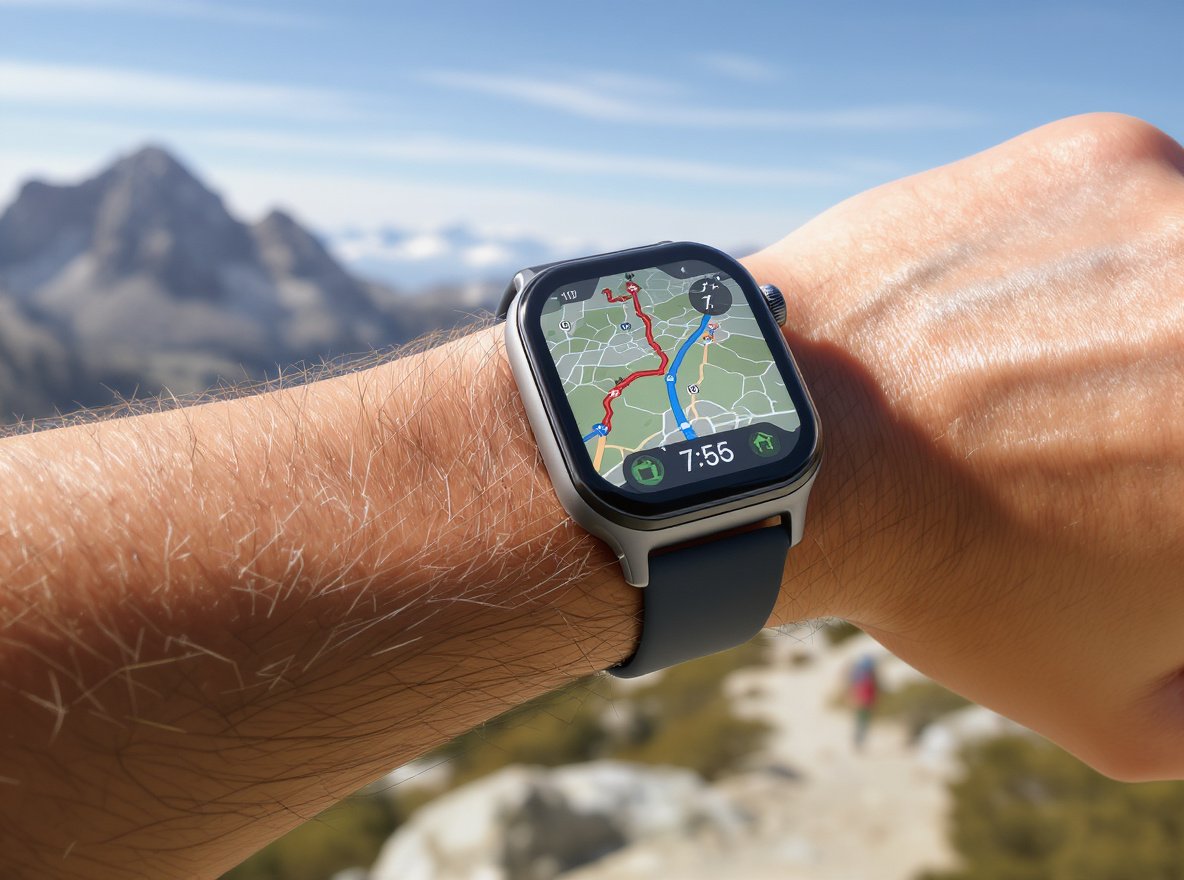
Yes, modern smartwatches can absolutely provide turn-by-turn navigation with built-in GPS, offline maps, and real-time directions. Premium models work independently without phone connectivity, offering voice prompts, vibration alerts, and comprehensive route guidance directly on your wrist.
Let’s explore how smartwatch navigation works and why it might be your perfect travel companion.
What Makes Smartwatch Navigation Possible?
Understanding the technology behind smartwatch navigation helps appreciate why these devices have become so capable. The integration of satellite positioning and advanced sensors creates sophisticated navigation systems.
Smartwatch navigation relies on built-in GPS receivers that communicate with at least 24 satellites orbiting Earth. Modern devices use multi-band GPS technology and multiple satellite systems including GPS, GLONASS, Galileo, and BeiDou for enhanced accuracy and reliability.

GPS technology forms the foundation of smartwatch navigation. The system calculates your position by measuring signal travel time from at least four different satellites. This triangulation process provides coordinate data that mapping software converts into visual directions and route guidance.
Multi-band GPS technology represents a significant advancement over traditional single-frequency systems. Devices like the Apple Watch Ultra 2 and Garmin Fenix series use dual frequencies for greater precision, achieving up to 10x better positioning accuracy in challenging environments where buildings and terrain typically interfere with GPS signals.
Enhanced sensor integration improves navigation beyond basic GPS capabilities:
- Barometric altimeters track elevation changes for 3D positioning
- 3-axis compasses provide directional orientation and bearing information
- Accelerometers and gyroscopes detect motion patterns and movement
- Magnetometers sense magnetic fields for improved compass accuracy
| Navigation Technology | Accuracy Improvement | Primary Benefit |
|---|---|---|
| Single-Band GPS | Baseline | Standard positioning |
| Multi-Band GPS | 10x better | Enhanced urban accuracy |
| Multi-Constellation | 3-5x better | Increased satellite availability |
| Sensor Fusion | 2-3x better | Continuous tracking reliability |
These sensors work together to maintain accurate positioning even when GPS signals are temporarily compromised by environmental factors.
Do Smartwatches Work Without Phone Connection?
Many buyers wonder whether smartwatch navigation requires constant smartphone connectivity. This concern significantly affects purchasing decisions for travelers and outdoor enthusiasts.
Yes, many premium smartwatches provide complete standalone navigation without requiring phone connection. GPS-enabled watches can track location and provide basic navigation independently, while cellular-enabled models offer comprehensive mapping services with real-time updates.

Standalone GPS functionality operates entirely independent of cellular networks and smartphones. GPS satellites provide global coverage, allowing watches to determine location anywhere on Earth where satellite signals can reach the device. This means basic navigation works in remote wilderness areas without any cellular coverage.
Cellular-enabled smartwatches deliver the most comprehensive standalone experience:
- Download maps directly over LTE networks
- Search for destinations using voice commands
- Access real-time traffic updates and route optimization
- Make emergency calls during navigation emergencies
- Receive weather updates and point-of-interest information
Offline map storage capabilities have revolutionized smartwatch independence. Apple’s watchOS updates include offline map synchronization for custom routes, while Garmin watches come with preloaded TopoActive mapping that works entirely offline. Advanced models can store hundreds of detailed maps locally, eliminating dependency on internet connectivity during critical navigation moments.
The distinction between GPS-only and cellular-enabled watches affects navigation capabilities significantly. GPS-only models excel at activity tracking and basic route following but may struggle with complex urban navigation requiring real-time data.
How Accurate Is Smartwatch Navigation?
Navigation accuracy determines whether you reach destinations safely and efficiently. Understanding real-world performance helps set appropriate expectations for different usage scenarios.
Modern smartwatches achieve 1-2% positioning error rates under optimal conditions, with median distance measurement errors ranging from 0.6% to 1.9% across different brands. Independent testing shows Garmin devices typically demonstrate the highest accuracy, while most premium watches perform comparably to smartphones.

Recent accuracy testing by DC Rainmaker revealed impressive performance metrics for GPS sports watches:
- 1% error rates on straight paths with clear sky visibility
- 1.7% error rates around tracks and mixed terrain
- 1.7% error rates on loop routes through varied environments
Environmental factors significantly impact GPS accuracy across all smartwatch brands. Dense urban environments create signal reflection issues called multipath effects, where GPS signals bounce off buildings before reaching your watch. Forest canopies and mountainous terrain can weaken satellite signals, while underground locations completely block GPS access.
Dual-band GPS technology addresses many accuracy challenges:
- L1 and L5 frequency combinations reduce atmospheric interference
- Enhanced signal processing filters multipath errors
- Improved antenna design minimizes signal reflection issues
- Better performance in urban canyons and challenging terrain
| Environmental Condition | Typical Accuracy | Performance Impact |
|---|---|---|
| Clear Open Sky | 1-2 meters | Optimal performance |
| Light Urban Areas | 2-3 meters | Minimal degradation |
| Dense Urban Canyons | 3-5 meters | Moderate impact |
| Forest Canopy | 5-10 meters | Significant challenges |
Multi-constellation support enhances accuracy by increasing available satellites. When GPS satellites are obscured, watches can use GLONASS, Galileo, or BeiDou satellites to maintain positioning accuracy.
What Navigation Features Do Smartwatches Offer?
Understanding available navigation capabilities helps buyers choose appropriate models for specific activities. Different users require different navigation features depending on their intended applications.
Modern smartwatches provide comprehensive navigation including turn-by-turn directions, route planning, waypoint management, breadcrumb trails, compass bearings, and emergency location sharing. Premium models offer topographic maps, voice commands, and haptic feedback guidance.

Turn-by-turn directions represent the core navigation feature that most users expect. Smartwatches display clear directional arrows, distance callouts, and estimated arrival times. Many devices provide haptic feedback with distinctive vibration patterns – typically high-low vibrations for left turns and low-high patterns for right turns.
Route planning capabilities have expanded significantly across smartwatch categories:
- Pre-planned route uploads from smartphone applications
- On-device route calculation using stored topographic maps
- Alternative route suggestions based on activity preferences
- Round-trip route generation for fitness and recreational activities
Advanced mapping features cater specifically to outdoor enthusiasts and professional users. High-end models like Garmin’s Fenix series include detailed contour lines, trail information, and terrain elevation profiles. These watches can display weather overlays, ski trail maps, and comprehensive points of interest.
Emergency navigation features provide critical safety benefits:
- SOS functionality with GPS coordinate transmission
- Automatic emergency contact alerts during incidents
- Location sharing with family members and emergency services
- Track-back functionality to retrace routes safely
Voice integration has improved substantially, with many smartwatches supporting voice-activated navigation through integrated digital assistants.
Which Smartwatch Brands Excel at Navigation?
Brand selection significantly influences navigation performance, feature availability, and long-term software support. Some manufacturers specialize in outdoor applications while others focus on consumer convenience.
Garmin leads outdoor navigation with comprehensive mapping capabilities, followed by Apple Watch for urban integration and Samsung Galaxy Watch for Android ecosystem compatibility. Suunto and Coros offer excellent value propositions for adventure sports applications.

Garmin dominates the GPS smartwatch market with unmatched navigation features across their Fenix, Forerunner, and Instinct series. Their watches include preloaded topographic maps, offline routing capabilities, and specialized tools like ClimbPro for elevation management and PacePro for race strategy. Garmin devices typically provide 20-50+ hours of continuous GPS tracking with detailed mapping.
Apple Watch excels at urban navigation integration with seamless Apple Maps connectivity. Recent watchOS updates include offline map storage, hiking trail suggestions from national parks, and comprehensive turn-by-turn guidance. The Apple Watch Ultra models feature enhanced GPS accuracy and extended battery life specifically designed for outdoor navigation activities.
Samsung Galaxy Watch models now offer comprehensive Google Maps integration with turn-by-turn directions, GPX file support for custom routes, and multi-band GPS accuracy. These watches work exceptionally well within the Android ecosystem and provide competitive navigation performance.
Emerging navigation brands offer compelling alternatives:
- Suunto Race and Vertical series provide detailed offline mapping with breadcrumb trails
- Coros watches deliver excellent value with capable navigation features and voice pin functionality
- Amazfit models offer competitive pricing with improving GPS performance
| Brand Category | Navigation Strength | Battery Life (GPS) | Map Detail |
|---|---|---|---|
| Garmin | Excellent | 20-120 hours | Topographic |
| Apple Watch | Very Good | 15-36 hours | Street/Trail |
| Samsung Galaxy | Good | 20-40 hours | Street Maps |
| Suunto | Very Good | 25-95 hours | Topographic |
| Budget Options | Basic | 8-20 hours | Limited |
Professional outdoor users typically choose specialized GPS watches, while casual consumers prefer integrated smartwatch solutions that balance navigation with communication features.
What Are the Limitations of Smartwatch Navigation?
Understanding navigation limitations helps set realistic expectations and choose appropriate backup solutions. Every navigation technology has constraints that users should consider before making purchasing decisions.
Key smartwatch navigation limitations include small screen sizes, significant battery consumption during GPS use, reduced map detail compared to smartphones, limited offline re-routing capabilities, and processing power constraints that affect complex navigation tasks.

Screen size presents the most obvious limitation for detailed navigation. Smartwatch displays typically measure 1.2-1.5 inches diagonally, making complex route visualization challenging. Street-level detail becomes difficult to discern, and users with vision issues may struggle with text readability during navigation.
Battery life impact represents a significant practical constraint. GPS tracking dramatically reduces smartwatch battery life, with most devices providing 20-50 hours of continuous GPS use compared to days or weeks in standard smartwatch mode. Screen brightness required for outdoor visibility and cellular connectivity for real-time updates further drain battery resources.
Processing power limitations affect navigation performance compared to smartphones:
- Route recalculation takes longer than smartphone applications
- Multi-destination planning requires simplified interfaces
- Real-time traffic analysis uses reduced data sets
- Voice recognition for address input has lower accuracy
Environmental challenges continue to affect smartwatch GPS accuracy. Urban environments with tall buildings create signal reflection issues, while dense forests and mountainous terrain can significantly degrade positioning accuracy. Heavy weather conditions may also impact satellite signal quality.
Feature gaps remain compared to smartphone navigation applications. Most smartwatches cannot provide on-the-fly re-routing when users deviate from planned routes, unlike comprehensive smartphone navigation apps that continuously recalculate optimal paths.
How Does Smartwatch Navigation Compare to Smartphones?
Direct comparisons help consumers understand when smartwatch navigation provides advantages over smartphones and when traditional phone-based navigation remains superior.
Smartwatches excel at hands-free operation, outdoor visibility, weather resistance, and providing navigation backup when phones fail, while smartphones offer superior screen sizes, processing power, map detail, and comprehensive app ecosystems for complex navigation tasks.

Hands-free operation represents the primary advantage of smartwatch navigation. Wrist-mounted displays allow safer navigation while driving, cycling, or engaging in outdoor activities. Users can check directions without retrieving phones from pockets or bags, reducing distraction and improving safety.
Weather resistance advantages make smartwatches ideal for outdoor navigation:
- IPX8 water resistance protects against rain and splashing
- Scratch-resistant sapphire glass withstands outdoor abuse
- Operating temperature ranges exceed smartphone specifications
- Dust and shock resistance for rugged environment use
Smartphone navigation maintains several key advantages for complex urban navigation. Larger screens provide better map detail and easier interaction with navigation interfaces. Superior processing power enables sophisticated route calculation, real-time traffic analysis, and comprehensive point-of-interest searches.
| Comparison Factor | Smartwatch Advantage | Smartphone Advantage |
|---|---|---|
| Screen Size | Wrist convenience | 5-7 inch visibility |
| Battery (GPS) | Activity-optimized | General-purpose |
| Weather Resistance | Excellent | Limited |
| Processing Power | Efficient | Superior |
| App Ecosystem | Specialized | Comprehensive |
| Hands-Free Use | Optimal | Challenging |
Research indicates smartphones generally provide more accurate navigation in complex urban environments due to superior antennas and processing capabilities. However, smartwatches excel in outdoor activities where hands-free operation and environmental resistance are crucial.
What Should Businesses Consider When Sourcing Navigation Smartwatches?
Wholesale buyers, distributors, and retailers need specific guidance when selecting smartwatch inventory with navigation capabilities. Understanding market demands and technical specifications enables informed sourcing decisions.
Businesses should evaluate GPS accuracy specifications, battery life during navigation, offline mapping capabilities, multi-constellation support, and target market preferences when sourcing navigation-enabled smartwatches for wholesale distribution.

Technical requirements vary significantly based on intended market segments. Outdoor enthusiasts demand multi-band GPS, topographic mapping, and extended battery life exceeding 20 hours of continuous tracking. Urban consumers prioritize smartphone integration, traffic updates, and sleek designs that balance navigation with communication features.
Key specification considerations for wholesale sourcing:
- Multi-band GPS capability for enhanced urban accuracy
- Multi-constellation support (GPS, GLONASS, Galileo, BeiDou)
- Minimum 16-32GB storage for offline map capability
- Water resistance rating appropriate for target market
- Battery capacity sufficient for intended usage patterns
Market pricing varies substantially across navigation feature levels. Entry-level smartwatches with basic GPS cost $5-30 wholesale, mid-range models with comprehensive navigation features range $30-100, while premium devices with topographic mapping exceed $100 per unit.
Quality control considerations specific to navigation features:
- GPS accuracy testing under various environmental conditions
- Battery life validation during continuous navigation use
- Software stability assessment for mapping applications
- Durability testing for outdoor navigation scenarios
Regional market preferences require careful consideration:
- European markets favor outdoor navigation and fitness tracking
- Asian markets prioritize smartphone integration and communication
- North American consumers seek balanced functionality across use cases
- Emerging markets focus on value pricing with essential features
At Osmarto, we understand the critical importance of reliable navigation features in today’s competitive smartwatch market. Our engineering team focuses on integrating advanced multi-band GPS technology with intuitive interfaces to meet diverse wholesale market demands. We offer comprehensive technical specifications, competitive wholesale pricing, and quality assurance testing for navigation accuracy.
Summary
Modern smartwatches have evolved into capable navigation devices offering turn-by-turn directions, offline mapping, and GPS accuracy comparable to smartphones. Premium models provide standalone navigation without phone connectivity, making them ideal for outdoor activities and emergency backup. While limitations like screen size and battery consumption exist, the hands-free convenience and weather-resistant design make smartwatch navigation increasingly valuable for both personal and professional applications.
Ready to explore wholesale smartwatch options with advanced navigation capabilities? Contact Osmarto’s team to discuss technical specifications, bulk pricing, and customization options for your target market. We’re committed to helping you find navigation-enabled smartwatches that meet your customers’ specific requirements and deliver exceptional value.