Skip to content
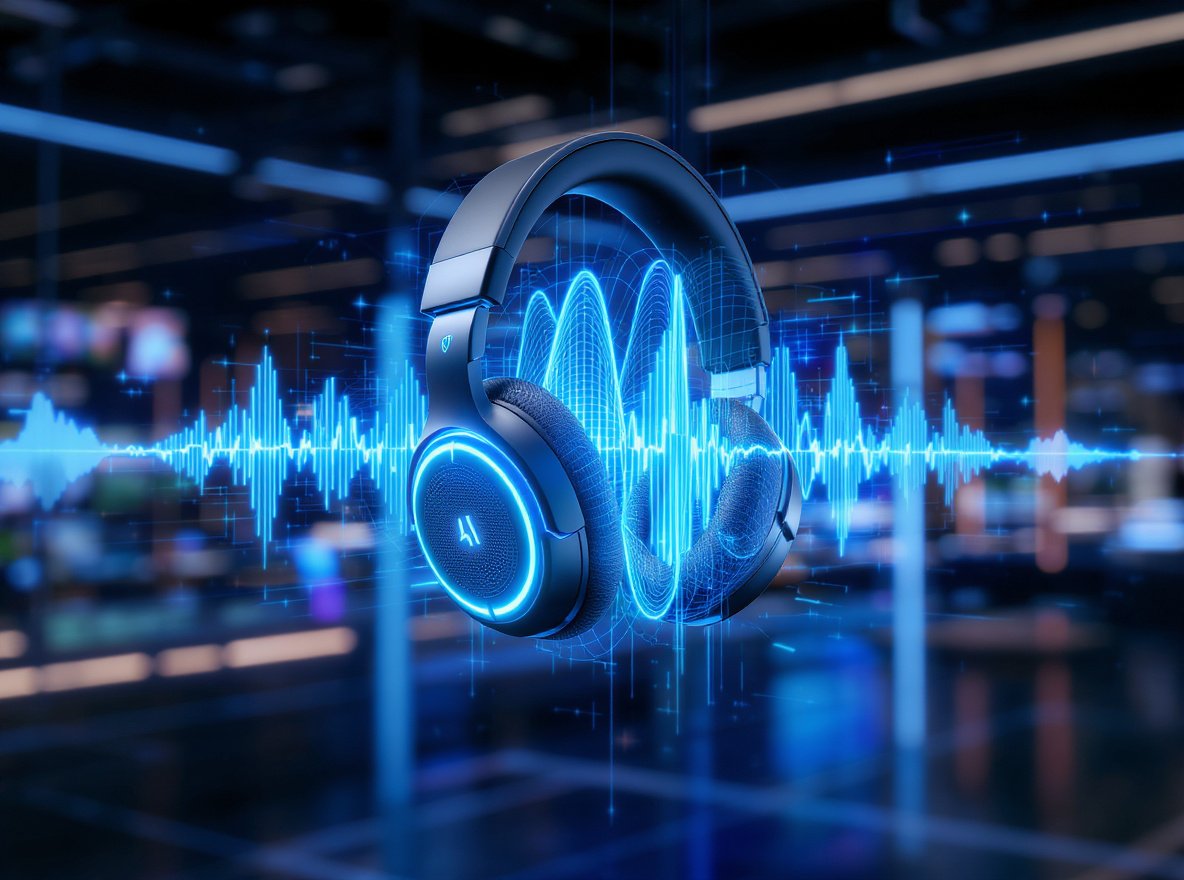
In today’s noisy world, customers demand headphones that deliver crystal-clear audio without distractions. Whether they’re commuting, working, or traveling, noise cancellation has become a must-have feature that can make or break a sale.
The Sony WH-1000XM6 currently leads the market with 87% average noise reduction and up to 40dB of noise cancellation. These flagship headphones feature Sony’s advanced QN3 processor operating seven times faster than previous generations, performing over 700 million operations per second. Close competitors include the Bose QuietComfort Ultra Headphones achieving 85% noise reduction, and the premium Dali IO-8 for audiophile applications.
But choosing the right noise cancelling headphones for your customers involves understanding the latest technology, comparing actual test results, and matching advanced features to specific professional use cases.
How Does Active Noise Cancellation Actually Work?
Understanding modern ANC technology helps you recommend the right products to your customers and explain sophisticated value propositions effectively.
Active noise cancellation uses miniature microphones to detect ambient noise, then generates sound waves 180 degrees out of phase to create destructive interference. Modern systems like Sony’s QN3 processor perform over 700 million operations per second, analyzing environmental noise and responding in real-time. The process occurs so rapidly that ears never perceive the original ambient noise.
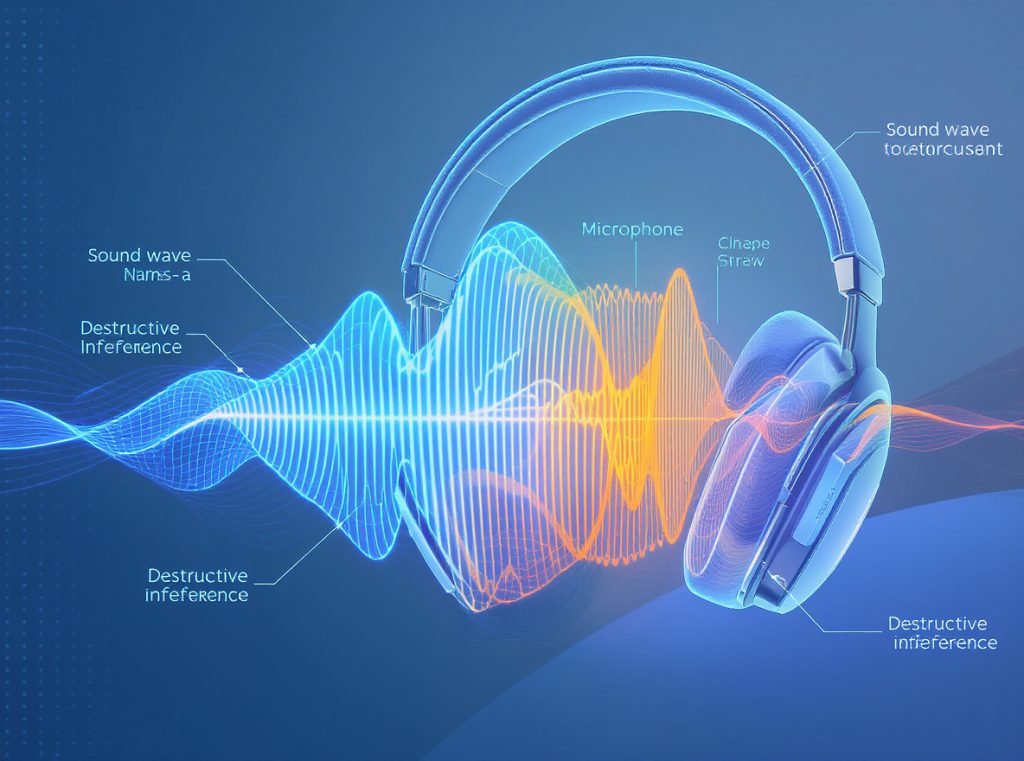
The technology operates on destructive interference principles where opposing sound waves cancel each other out. Advanced systems now employ sophisticated digital signal processing that continuously adapts cancellation signals based on environmental conditions.
Modern ANC architectures include three primary approaches:
- Feedforward ANC: External microphones detect noise before it reaches ears, highly effective against consistent low-frequency sounds
- Feedback ANC: Internal microphones monitor residual noise within earcups, providing precise mid-to-high frequency correction
- Hybrid ANC: Combines both systems for comprehensive noise cancellation across the full audible spectrum
| ANC Architecture | Frequency Focus | Noise Reduction | Processing Speed | Typical Applications |
|---|---|---|---|---|
| Feedforward | 20Hz-500Hz | 20-30dB | Standard | Budget to mid-range |
| Feedback | 500Hz-2kHz | 15-25dB | Standard | Mid-range models |
| Hybrid Systems | 20Hz-8kHz | 30-40dB | 700M+ ops/sec | Premium professional |
The most advanced systems like Sony’s WH-1000XM6 adjust over 500 times per second, using machine learning to predict and preemptively cancel noise patterns rather than simply reacting to detected sounds.
Which Headphone Brands Lead in Noise Cancellation Performance?
Current testing data reveals clear performance leaders based on measurable noise reduction percentages and technical specifications.
Sony dominates with their WH-1000XM6 achieving 87% average noise reduction through an 8-microphone system and QN3 processor. Bose QuietComfort Ultra delivers 85% noise reduction, excelling specifically at blocking low-frequency sounds like airplane engines. Apple’s AirPods Max processes noise cancellation in just 9 milliseconds using their H1 chip and computational audio approach.
Sony’s leadership stems from consistent innovation in processing power and comprehensive feature integration. Their latest models feature:
Premium Performance Leaders:
- Sony WH-1000XM6: 87% noise reduction, 30-hour battery, adaptive algorithms
- Bose QuietComfort Ultra: 85% noise reduction, CustomTune technology, spatial audio integration
- Dali IO-8: Audiophile-grade performance without pressure sensation side effects
Professional-Grade Options:
- Mark Levinson No. 5909: $999 flagship with beryllium-coated 40mm drivers and three adaptive ANC modes
- Apple AirPods Max: 9ms processing latency, seamless iOS integration, computational audio processing
Budget alternatives now offer surprisingly competitive performance. The Soundcore Space One delivers solid ANC performance at around $100 with 45-hour battery life, while JLab models provide acceptable noise cancellation for basic professional applications.
When sourcing for wholesale customers, Sony and Bose represent safe premium choices, while emerging brands offer opportunities for competitive differentiation at lower price points.
What’s the Difference Between Passive and Active Noise Isolation?
Understanding both technologies helps you explain why premium headphones justify higher costs through superior comprehensive noise reduction approaches.
Passive noise isolation uses physical barriers like dense padding and closed-back designs to block sound mechanically, most effective against frequencies 1kHz-8kHz. Active noise cancellation adds electronic processing to eliminate low-frequency sounds 20Hz-1kHz. Premium headphones combine both methods, achieving 15-40dB total noise reduction across the complete audible spectrum.
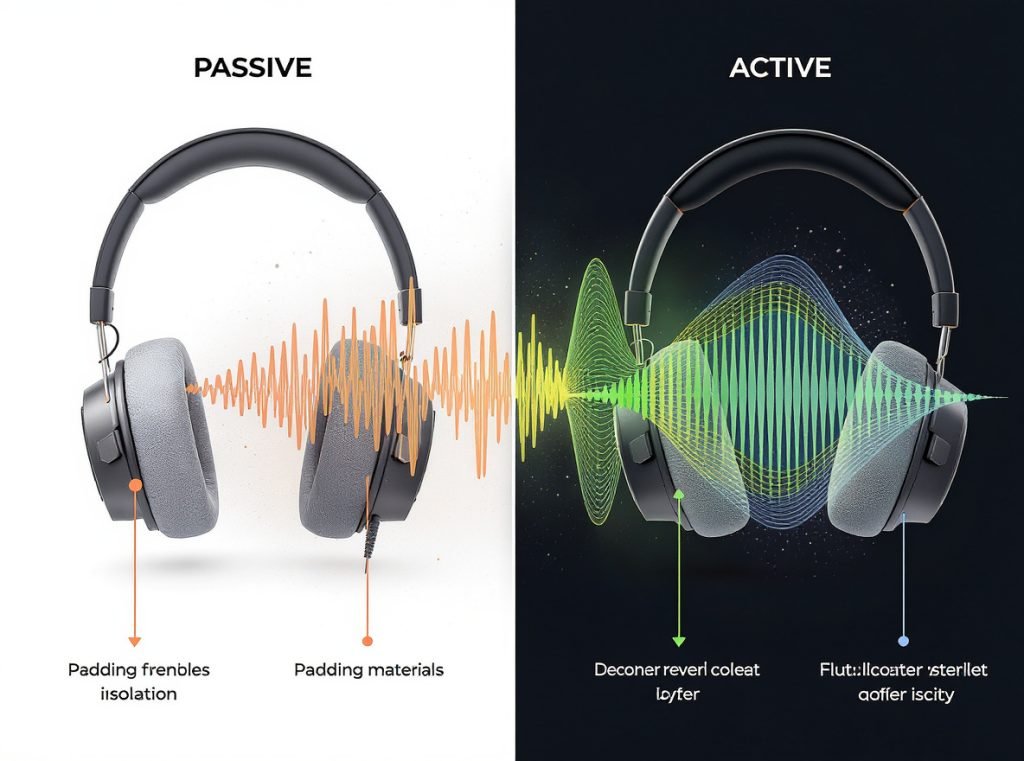
Performance characteristics differ significantly between approaches:
Passive Isolation Strengths:
- No battery power required – functions even when powered off
- Effective against sudden, irregular sounds that ANC struggles with
- Works across all frequencies with proper fit and seal
- Lower cost to implement in basic models
Active Cancellation Advantages:
- Exceptional performance against consistent low-frequency noise (airplane engines, air conditioning)
- Can achieve 20-40dB reduction in optimal frequency ranges
- Continuously adapts to changing environmental conditions
- Enables transparency modes for situational awareness
| Frequency Range | Passive Isolation | Active Cancellation | Combined Performance |
|---|---|---|---|
| 20Hz-500Hz | 5-10dB | 20-40dB | 25-45dB |
| 500Hz-1kHz | 10-15dB | 15-30dB | 25-40dB |
| 1kHz-8kHz | 15-25dB | 5-15dB | 20-35dB |
Most premium headphones optimize both technologies together. Over-ear designs naturally provide superior passive isolation through complete ear enclosure, while advanced ANC systems handle remaining low-frequency penetration.
How Much Noise Reduction Can You Realistically Expect?
Current testing data provides specific performance benchmarks that help set accurate customer expectations and position products appropriately.
Professional-grade ANC headphones achieve 20-40dB noise reduction in optimal conditions, with top performers like Sony WH-1000XM6 reaching 87% average noise reduction. This translates to reducing potentially harmful 85dB city traffic down to comfortable 45-55dB office environment levels. However, performance varies significantly by frequency range and environmental factors.
Measurable noise reduction by frequency:
Low Frequencies (50-500Hz): Up to 40dB reduction
- Airplane engines: 80dB reduced to 40-45dB
- Air conditioning systems: 65dB reduced to 25-30dB
- Traffic noise: 75dB reduced to 35-40dB
Mid Frequencies (500Hz-1kHz): 20-30dB reduction
- Office chatter: 60dB reduced to 30-40dB
- General ambient noise: 55dB reduced to 25-35dB
High Frequencies (1kHz+): 15-25dB reduction (primarily passive)
- Sudden sounds: Limited active cancellation effectiveness
- Speech: Partial reduction, transparency modes recommended
Real-world performance factors affecting these measurements:
- Proper fit and seal: Poor seating can reduce effectiveness by 50% or more
- Battery level: ANC performance degrades as power depletes below 20%
- Environmental conditions: Wind interference can disrupt external microphone accuracy
- Noise type consistency: Steady sounds cancel better than irregular, sudden noises
Independent testing shows the best ANC headphones can attenuate noise to within 3dB of professional-grade earmuffs when exposed to sounds up to 80dBA.
Which Form Factor Offers the Best Noise Cancellation: Over-Ear, On-Ear, or In-Ear?
Form factor significantly impacts both noise cancellation performance and professional application suitability based on physical design limitations and component space.
Over-ear headphones deliver superior noise cancellation, achieving 30-40dB reduction through complete ear enclosure and advanced ANC systems. They accommodate larger drivers, multiple microphone arrays, and extended battery life up to 60 hours. However, premium in-ear models like Sony WF-1000XM5 now achieve competitive performance in compact form factors.
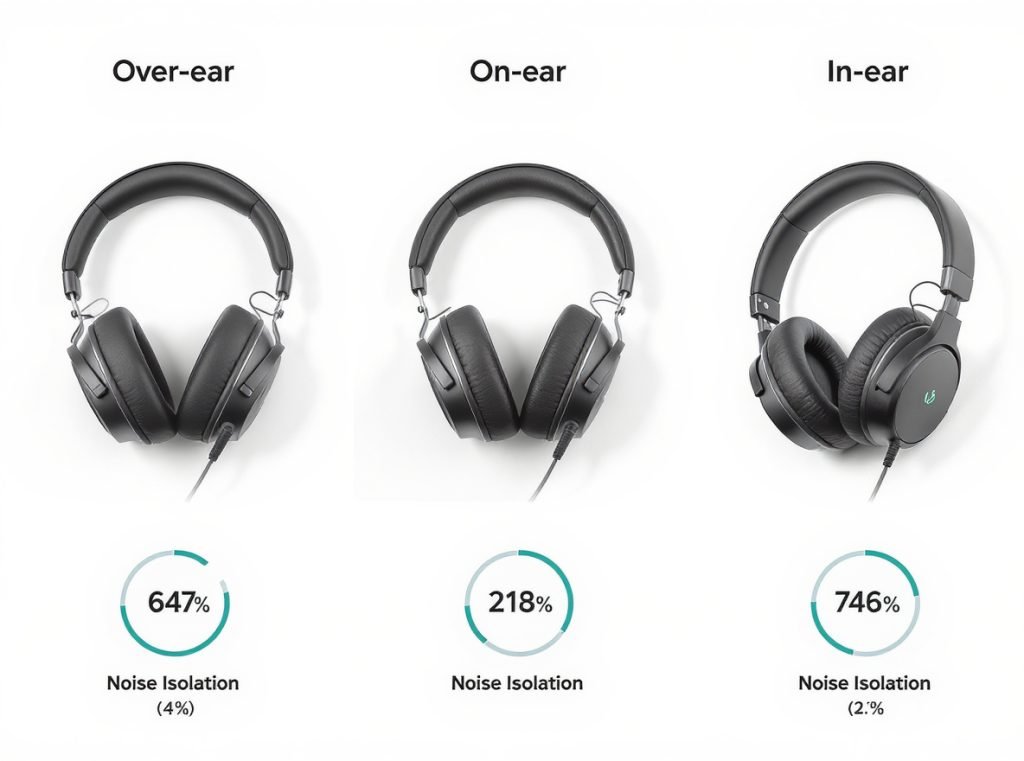
Over-ear advantages for professional applications:
Superior ANC Performance:
- Complete acoustic seal around entire ear structure
- Space for multiple microphones (up to 8 in premium models)
- Larger drivers and advanced processing components
- Better passive isolation foundation for ANC systems
Professional Features:
- Extended battery life: 24-60 hours with ANC enabled
- Comfortable extended wear for long work sessions
- Superior call quality with dedicated microphone arrays
- More stable connection and controls for professional use
In-ear models offer compelling alternatives for specific applications. High-end models achieve excellent noise isolation through proper ear canal sealing, with performance approaching over-ear levels when fit correctly.
In-Ear Professional Benefits:
- Superior portability for mobile professionals
- Excellent for exercise and active use cases
- Lower cost for bulk purchasing
- Acceptable battery life (5-10 hours) for most applications
On-ear designs represent compromises that often satisfy neither performance nor portability priorities fully. They lack complete acoustic sealing while remaining bulkier than in-ear alternatives.
For wholesale purchasing decisions targeting professional users, over-ear models provide superior noise cancellation performance and extended battery life, while in-ear options excel for mobile and cost-sensitive applications.
What Features Should You Look for in Professional-Grade ANC Headphones?
Advanced features differentiate premium products and justify higher wholesale costs while providing measurable professional performance advantages.
Professional-grade ANC headphones require hybrid microphone systems (5+ microphones), powerful processors capable of 700+ million operations per second, adaptive algorithms that adjust in real-time, and 24+ hour battery life with ANC enabled. Features like CustomTune technology, wind noise mitigation, and multi-device connectivity are essential for demanding professional applications.
Critical technical specifications for professional use:
Advanced ANC Architecture:
Modern professional systems employ multiple microphone configurations. The Dell Pro Plus WL5024 features five total microphones: two analog AI beamforming microphones plus four hybrid ANC microphones for comprehensive noise control.
High-Performance Processing:
- Sony QN3 Processor: 700+ million operations per second, 7x faster than previous generations
- Apple H1 Chip: 9ms processing latency, below human perception threshold
- Bose CustomTune: Automatic optimization based on individual ear anatomy
Professional Connectivity Features:
| Feature | Business Benefit | Professional Impact |
|---|---|---|
| Multi-device Pairing | Seamless device switching | Productivity enhancement |
| Quick Attention Mode | Instant conversation mode | Professional courtesy |
| Transparency Modes | Situational awareness | Safety and interaction |
| Voice Enhancement | Crystal-clear call quality | Communication effectiveness |
Advanced Comfort and Durability:
- Replaceable ear cushions for hygiene in shared environments
- Lightweight construction under 300g for extended professional wear
- Adjustable headband with pressure distribution systems
- Modular designs for component replacement and longevity
Battery and Connectivity:
Professional applications demand 30+ hour battery life with ANC enabled. Leading models achieve:
- Sony WH-1000XM6: 30 hours with ANC
- Sennheiser Momentum 4: 60 hours exceptional performance
- Bose QuietComfort Ultra: 24 hours with spatial audio
High-quality codec support (LDAC, aptX Adaptive, AAC) ensures optimal wireless audio fidelity for professional applications, while wired backup options provide reliability for critical use cases.
How Do You Test and Compare Noise Cancellation Performance?
Understanding professional testing methodology helps evaluate supplier claims and make informed wholesale purchasing decisions based on standardized performance data.
Professional ANC testing uses Head and Torso Simulators (HATS) like the B&K 5128, positioned between multiple speakers following ETSI protocols. Testing employs pink noise rather than sine sweeps to account for ANC adaptation time, measuring Microphone-in-Real-Ear (MIRE) performance across frequency ranges. Independent organizations like RTINGS.com provide standardized comparative databases.
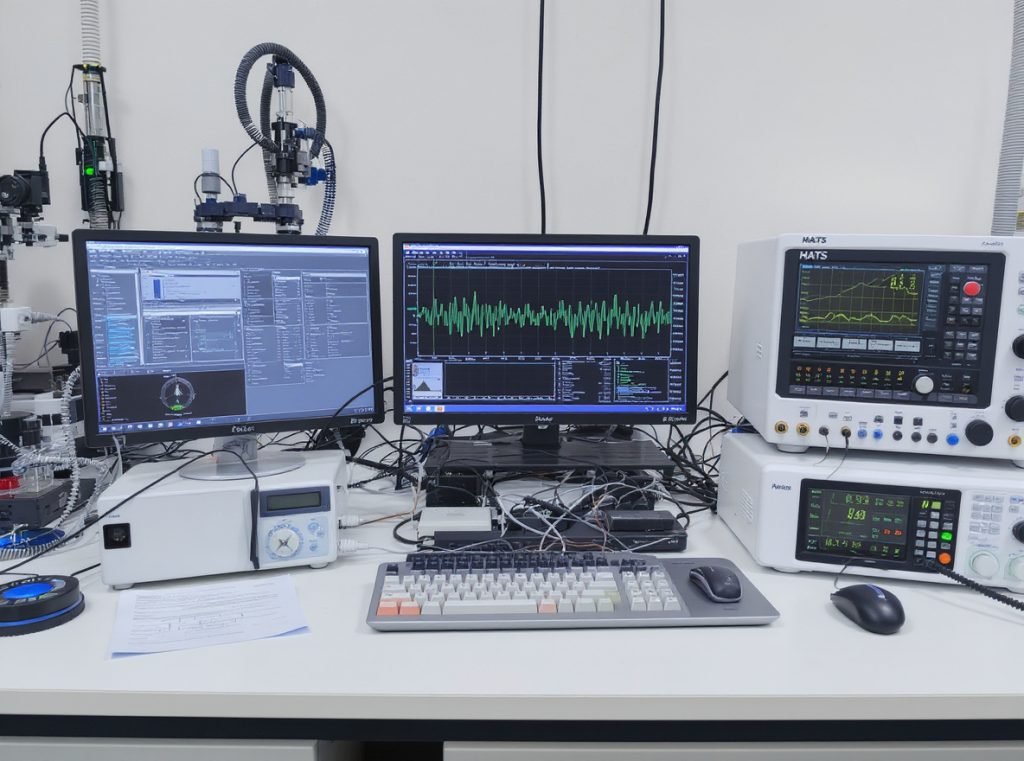
Professional testing equipment and protocols:
Standardized Testing Setup:
- Head and Torso Simulators: B&K 5128 HATS systems positioned for consistent measurement conditions
- Multiple speaker arrays: Simulate real-world noise environments from various directions
- Calibrated microphones: Placed at concha, shallow ear canal, and deep ear canal positions
Testing Methodologies:
Modern testing uses pink noise signals that better account for ANC adaptation time compared to traditional sine wave sweeps. Systems requiring adaptation time show different performance in initial seconds versus steady-state operation.
Key Performance Metrics:
- Frequency response analysis: Comprehensive measurement across 20Hz-20kHz spectrum
- Attenuation performance: Testing at various volume levels (60dB, 70dB, 80dB)
- Consistency measurements: Multiple trials with headphone reseating between tests
- Real-world simulation: Testing with actual airplane, traffic, and office noise recordings
Comparative Analysis Standards:
Independent testing organizations provide valuable benchmarks. RTINGS.com maintains comprehensive databases comparing hundreds of models using standardized protocols, offering reliable guidance for professional wholesale purchasing decisions.
When evaluating suppliers, request detailed test reports with third-party verification. Many manufacturers overstate ANC performance in marketing materials, making independent standardized testing crucial for accurate wholesale purchasing decisions.
What Are the Latest Innovations in Noise Cancellation Technology?
Staying current with ANC innovations helps identify emerging market opportunities and position inventory for evolving professional demands.
Latest innovations include AI-powered adaptive cancellation adjusting 500+ times per second, wind noise mitigation algorithms that automatically adjust microphone sensitivity, ultra-low latency processing under 10ms, and personalized ANC optimization based on individual ear anatomy. Integration with spatial audio and computational audio processing represents the cutting edge of professional ANC development.

Revolutionary technological advances reshaping professional ANC:
Artificial Intelligence Integration:
Sony’s latest systems use machine learning to predict and preemptively cancel noise patterns, representing significant advancement over traditional reactive systems. These predictive algorithms learn individual user environments and optimize performance automatically.
Advanced Wind Noise Management:
EarFun’s Anti-Wind Noise Algorithms automatically detect wind conditions and reduce feedforward microphone sensitivity, preventing the turbulent noise that traditionally plagued outdoor ANC use.
Computational Audio Processing:
Apple’s computational audio in AirPods Max processes spatial audio alongside noise cancellation, creating immersive experiences while maintaining ANC effectiveness. This multi-dimensional approach represents future professional audio development.
Personalized Optimization Technologies:
| Innovation | Technical Approach | Professional Benefit |
|---|---|---|
| CustomTune (Bose) | Individual ear analysis | Optimized personal performance |
| Adaptive Sound (Sony) | Environmental learning | Automatic optimization |
| Spatial Integration | 3D audio processing | Enhanced user experience |
| AI Voice Enhancement | Speech isolation | Professional call quality |
Ultra-Low Latency Systems:
Modern processors achieve sub-10ms processing times, eliminating the lag that previously caused artifacts in professional ANC applications. Apple’s H1 chip operates in just 9ms, below human perception thresholds.
Sustainable Professional Design:
Leading manufacturers implement modular designs with replaceable components, extending product lifespan while maintaining cutting-edge performance. This addresses professional environments requiring long-term reliability and serviceability.
The convergence of these technologies indicates future ANC systems will be increasingly intelligent, personalized, and seamlessly integrated into professional workflows, delivering more effective noise cancellation across diverse business environments.
Summary
The Sony WH-1000XM6 currently leads with 87% noise reduction and advanced QN3 processing, while Bose QuietComfort Ultra offers 85% reduction with CustomTune optimization. Professional-grade ANC achieves 20-40dB noise reduction through hybrid microphone systems and AI-powered adaptive algorithms.
For wholesale success, focus on technical specifications like processing speed, microphone arrays, and battery performance while understanding the measurable differences between passive isolation and active cancellation technologies.
Ready to source professional-grade noise cancelling headphones for your business customers? Contact Osmarto today to discuss wholesale pricing on advanced ANC headphones featuring the latest hybrid technology, extended battery life, and professional connectivity options that meet demanding business requirements.