Skip to content
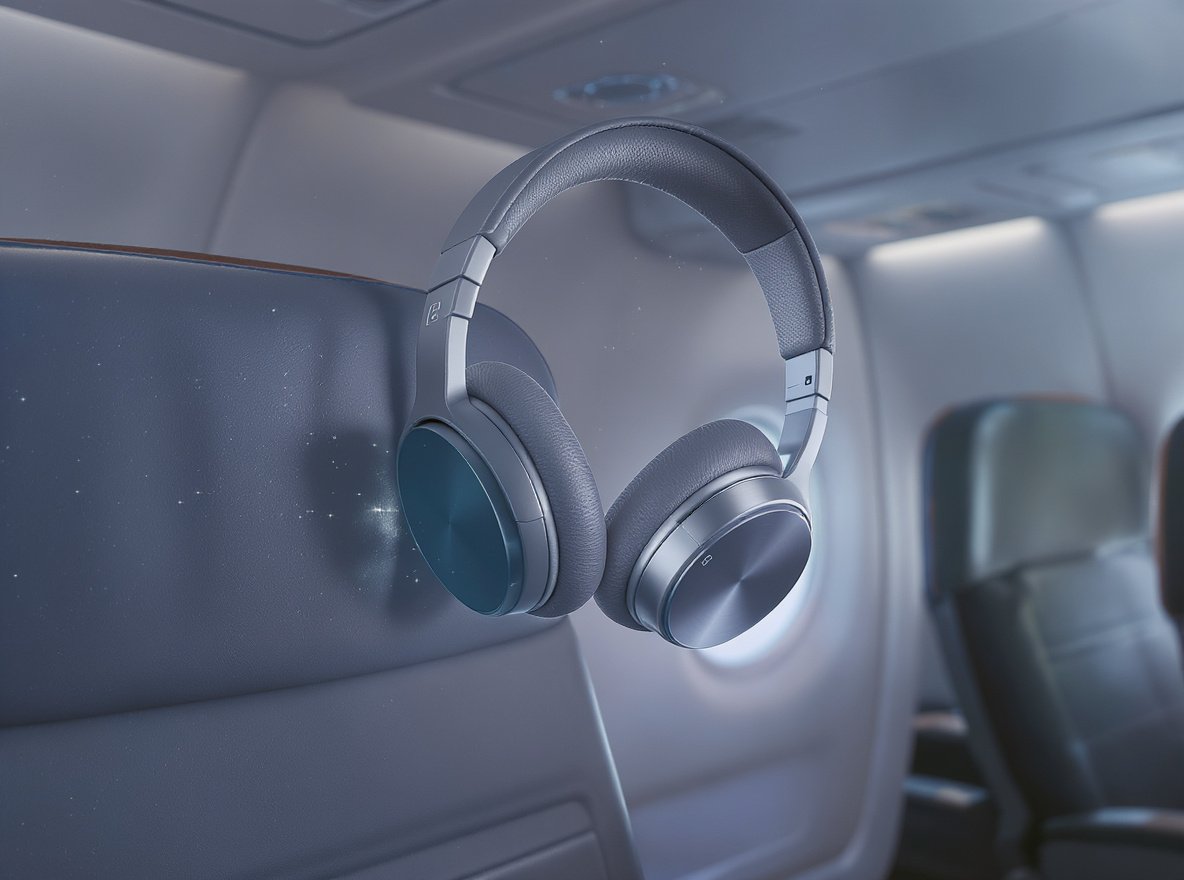
Long flights and extended travel can be exhausting, especially when you’re dealing with crying babies, engine noise, and uncomfortable seating. The right headphones can transform your journey from a nightmare into a peaceful, enjoyable experience.
The most comfortable headphones for long travel and flights are over-ear models with memory foam cushions, active noise cancellation, lightweight design (under 300g), and 20+ hour battery life. Top features include weight distribution through padded headbands, breathable materials like velour, and both wireless and wired connectivity options.
Let’s dive deeper into everything you need to know about choosing the perfect travel companion for your ears.
What Makes Headphones Comfortable for Extended Wear?
Understanding the three pillars of headphone comfort is crucial when you’re planning to wear headphones for 8-12 hours during long-haul flights.
Comfort fundamentally depends on three critical factors: weight distribution, padding quality, and clamping force. The best headphones spread weight evenly across your head through well-designed headbands, use memory foam or gel-infused pads that conform to your ears, and maintain optimal clamping pressure.
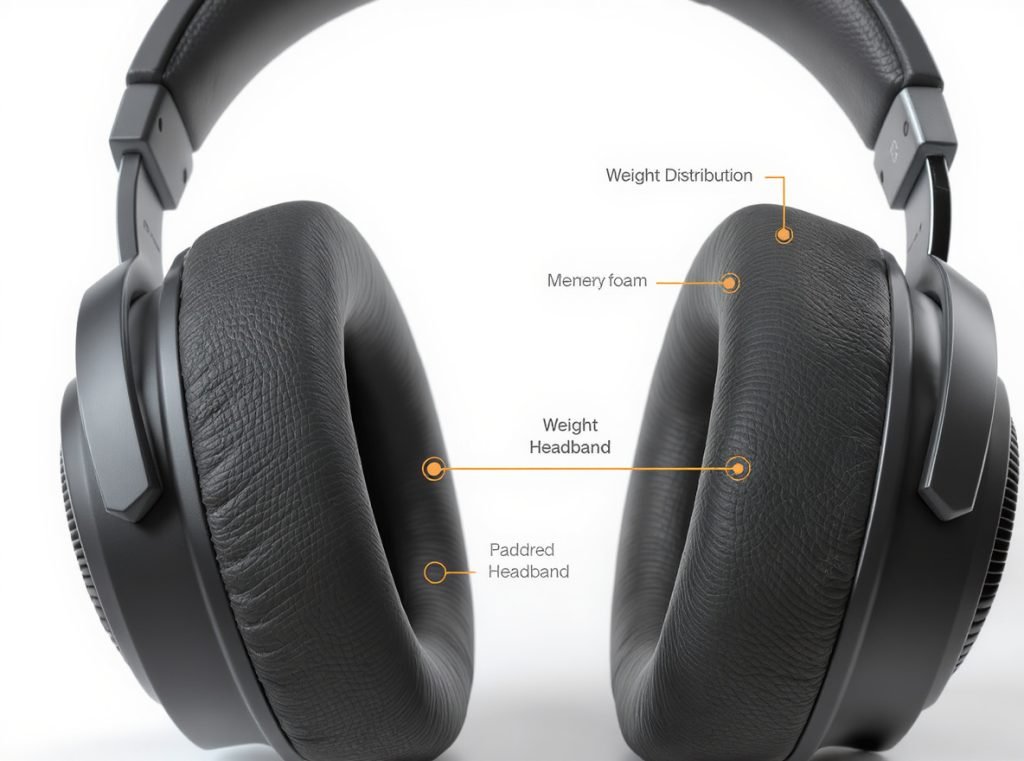
Weight distribution is the foundation of comfort. Headphones should never exceed 300 grams for extended travel use, as heavier models cause neck strain and pressure points. The headband should be well-padded to prevent the hard frame from pressing against your skull.
Padding quality makes or breaks the comfort experience. Premium materials like memory foam and gel-infused cushions conform to your unique ear shape, reducing pressure points that cause discomfort. The ear cups should be large enough to encompass your ears completely without pressing against them.
Clamping force needs precise calibration – tight enough to stay secure during movement but gentle enough to avoid fatigue over time. You can adjust overly tight headphones by gently stretching the headband overnight using a box slightly wider than your head.
| Comfort Element | Optimal Specification | Impact on 8+ Hour Use |
|---|---|---|
| Weight | Under 300g | Prevents neck strain |
| Padding Material | Memory foam/gel | Eliminates pressure points |
| Clamping Force | Adjustable, moderate | Maintains security without fatigue |
| Ear Cup Size | Circumaural (around ear) | No direct ear contact |
Why Do Over-Ear Headphones Excel for Air Travel?
Many travelers debate between over-ear headphones and earbuds, but research clearly shows over-ear designs provide superior comfort and performance for extended flights.
Over-ear headphones naturally provide better noise isolation through physical design, offer 24-60 hours of battery life compared to 5-10 hours for earbuds, and distribute weight around your ears rather than creating direct ear canal pressure that becomes painful after 4+ hours of continuous use.
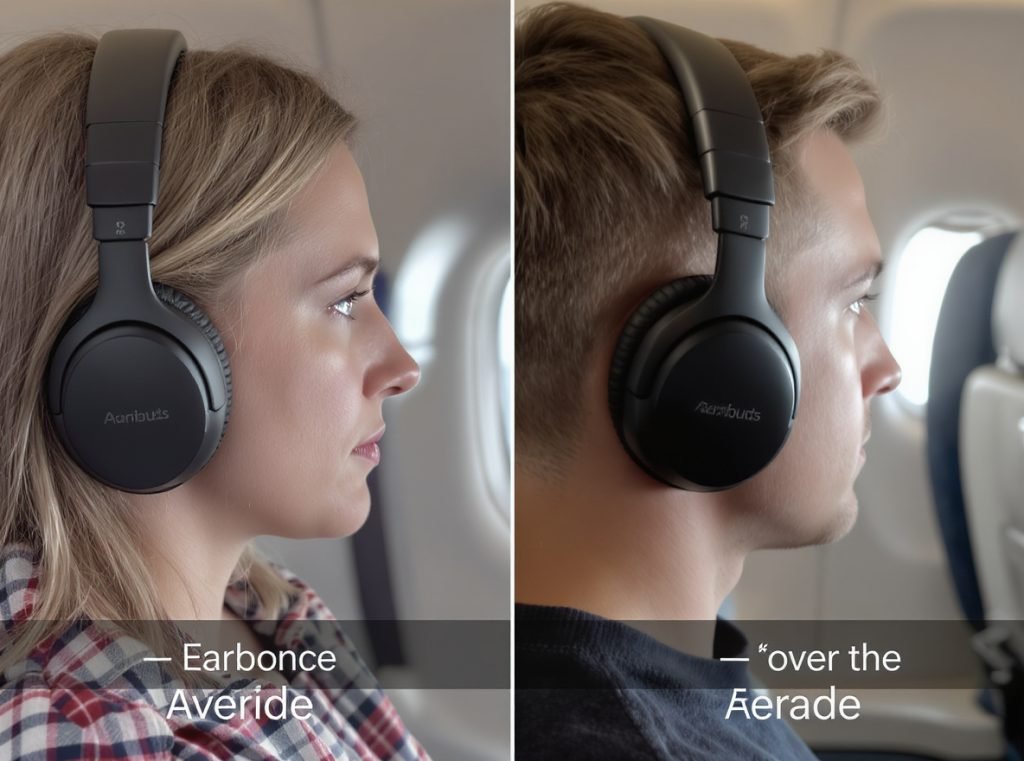
The passive noise isolation advantage is significant. Over-ear designs create a natural seal around your entire ear before active noise cancellation even activates. This combination of passive and active noise reduction is particularly effective against the 75-85 decibel noise levels found in aircraft cabins.
Battery performance differences are dramatic. While most ANC earbuds provide 5-10 hours per charge, quality over-ear headphones consistently deliver 24-60 hours of playback. The Sennheiser Momentum 4 provides up to 60 hours, while the Sony WH-1000XM5 offers 30+ hours with ANC enabled.
Ear canal fatigue becomes a serious issue with earbuds during flights over 4 hours. Your ear canals aren’t designed to hold foreign objects continuously for extended periods, leading to irritation, wax buildup, and soreness that over-ear designs completely eliminate.
- Superior passive noise isolation before ANC activation
- 3-6x longer battery life than equivalent earbuds
- Eliminates ear canal pressure and associated pain
- Larger drivers provide better sound quality
- More stable positioning during sleep and movement
Which Features Are Essential for Air Travel Success?
Not all headphones work well in airline environments. Specific features can make or break your in-flight experience based on real-world travel demands.
Essential air travel features include active noise cancellation to reduce 75-85 decibel cabin noise, foldable design for compact storage, both wireless and wired connectivity for device compatibility, 24+ hour battery life for long routes, and quick charging capabilities for layover recovery.
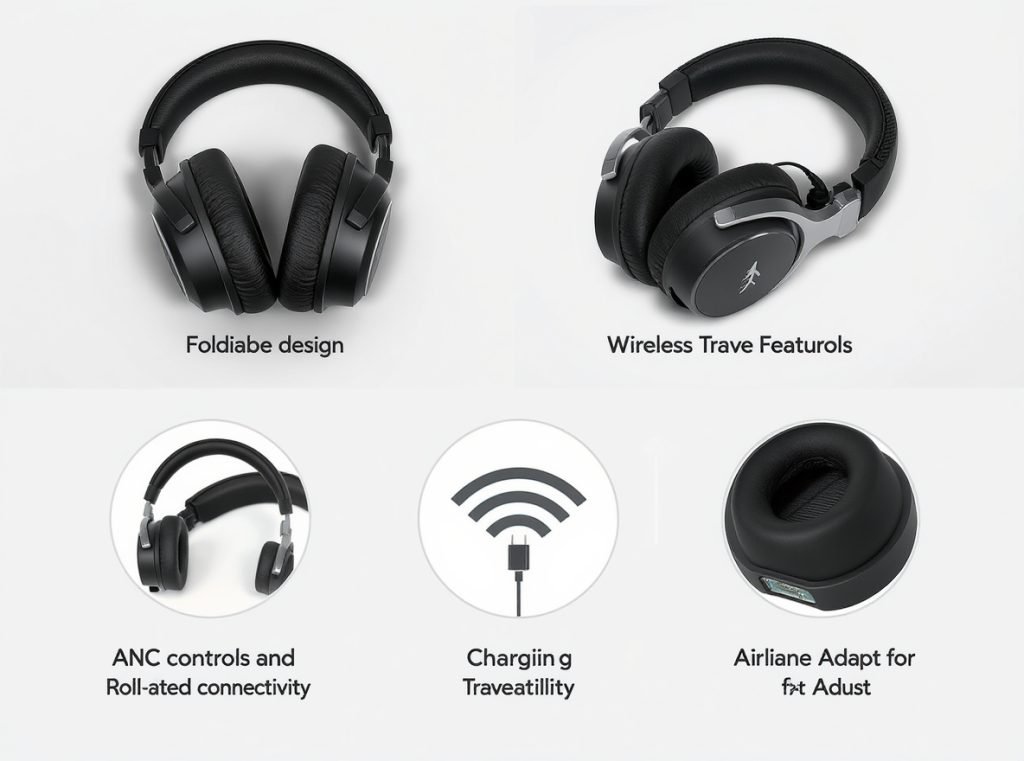
Active noise cancellation is non-negotiable for air travel comfort. Quality ANC can reduce cabin noise by 75-85%, significantly decreasing listener fatigue and allowing comfortable audio enjoyment at lower volumes. This technology is most effective against the consistent low-frequency sounds of aircraft engines.
Dual connectivity options ensure maximum compatibility. While modern aircraft increasingly support Bluetooth, many airlines still require traditional 3.5mm connections for seat-back entertainment systems. Having both options prevents entertainment limitations during your flight.
Foldable design directly impacts packing efficiency. Airport security, overhead bins, and cramped seating all demand compact storage. Headphones that fold flat or collapse significantly reduce luggage space requirements while rigid carrying cases protect your investment.
Quick charging technology serves as crucial backup. Even 15-30 minutes of charging during boarding or layovers can provide several hours of listening time, eliminating anxiety about battery depletion mid-flight.
| Feature Category | Specific Requirement | Travel Benefit |
|---|---|---|
| Noise Cancellation | 75-85% reduction capability | Blocks engine drone effectively |
| Connectivity | Bluetooth + 3.5mm wired | Works with all airline systems |
| Portability | Foldable with case | Saves 60% packing space |
| Power Management | 24hr+ battery, quick charge | Survives longest routes |
How Critical Is Noise Cancellation for Flight Comfort?
Noise cancellation technology has revolutionized air travel comfort, but understanding its specific impact helps optimize your flying experience.
Active noise cancellation reduces aircraft cabin noise from 75-85 decibels to comfortable levels, significantly decreasing travel fatigue, stress hormones, and the need for high volume levels that can damage hearing. Quality ANC is particularly effective against consistent low-frequency engine sounds.
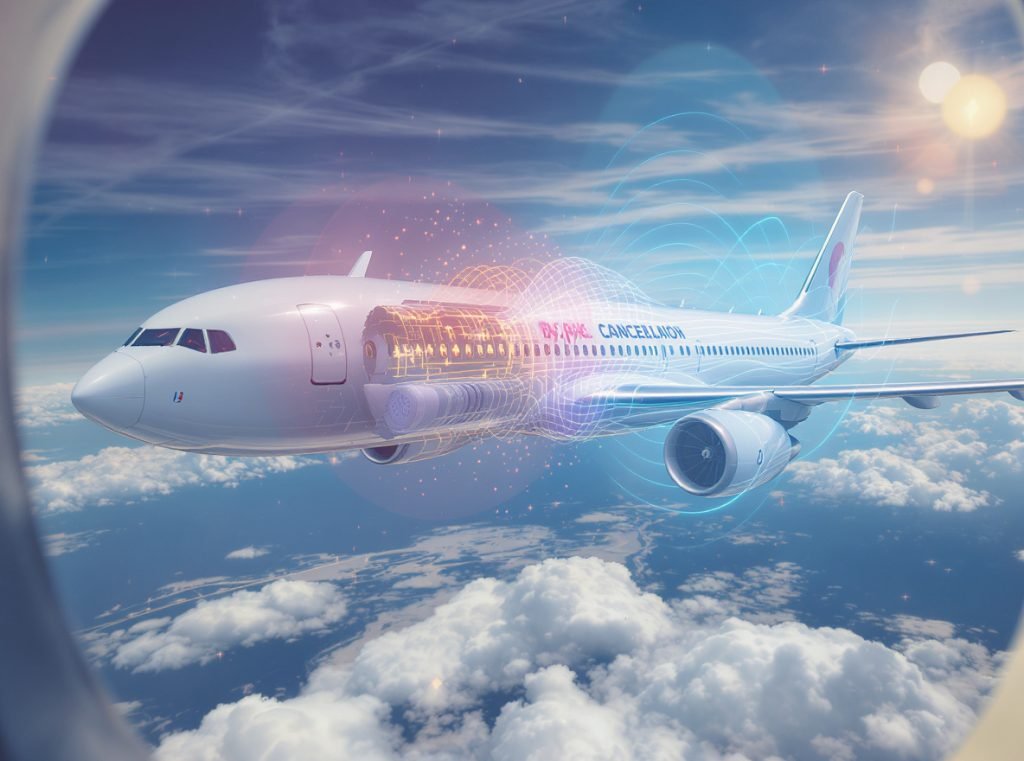
Aircraft cabins generate noise levels equivalent to heavy traffic or garbage disposal units. Prolonged exposure to these levels causes measurable increases in stress hormones, fatigue, and requires dangerous volume levels to overcome ambient noise.
ANC technology uses microphones to detect external sounds and generates inverse sound waves to cancel the noise. This process is most effective against consistent, low-frequency sounds – exactly what dominates airplane cabin environments.
The health benefits extend beyond immediate comfort. Reduced noise exposure means lower cortisol production, improved sleep quality during flights, and protection from hearing damage. You can enjoy entertainment at comfortable 60-70 decibel levels instead of competing with 85-decibel cabin noise.
Noise cancellation also aids sleep regulation during overnight flights. The consistent low-frequency drone of engines, once properly filtered, actually becomes beneficial white noise that helps many travelers fall asleep more easily.
- Transforms 85-decibel cabin noise into peaceful 40-50 decibel environment
- Reduces stress hormone production during extended flights
- Enables safe listening volumes, protecting long-term hearing health
- Improves sleep quality on overnight routes through white noise effect
- Decreases overall travel fatigue and jet lag symptoms
What Battery Life Do You Actually Need for Travel?
Battery performance requirements vary dramatically based on your travel patterns, but understanding real-world usage helps set appropriate expectations.
Ideal travel headphones should provide 24-30 hours of playbook with ANC enabled for standard long-haul routes, with premium models offering 40-60 hours for multi-connection international travel. Quick charging should deliver 2-4 hours of use from a 15-minute charge.

Route analysis reveals specific requirements. Domestic flights (2-6 hours) need 8-10 hours of battery life including airport time. Trans-Atlantic routes (8-10 hours) require 15+ hours capacity. Trans-Pacific flights (12-16 hours) demand 20+ hours, while multi-connection international travel can require 30+ hours of continuous use.
Current market leaders exceed these requirements significantly. The Sennheiser Momentum 4 delivers up to 60 hours, the Sony WH-1000XM5 provides 32 hours with ANC, and even budget options like the Anker Soundcore Life Q30 offer 40 hours of usage.
Battery degradation becomes a factor after 1-2 years of use, with maximum capacity dropping 20-30%. Starting with higher capacity provides a buffer against this natural decline while ensuring reliable performance throughout the headphone’s lifespan.
| Travel Distance | Flight Duration | Required Battery | Recommended Capacity |
|---|---|---|---|
| Domestic US | 2-6 hours | 10 hours | 20+ hours |
| Trans-Atlantic | 8-10 hours | 15 hours | 25+ hours |
| Trans-Pacific | 12-16 hours | 20 hours | 30+ hours |
| Multi-connection Global | 20+ hours | 30 hours | 40+ hours |
Should You Choose Wired or Wireless for Flying?
The wired versus wireless decision becomes complex when considering airline environments, device compatibility, and reliability requirements.
The optimal solution combines wireless convenience with wired backup capability. Pure wireless eliminates cable management during sleep and movement, while the 3.5mm backup ensures compatibility with airline entertainment systems and provides unlimited reliability regardless of battery status.
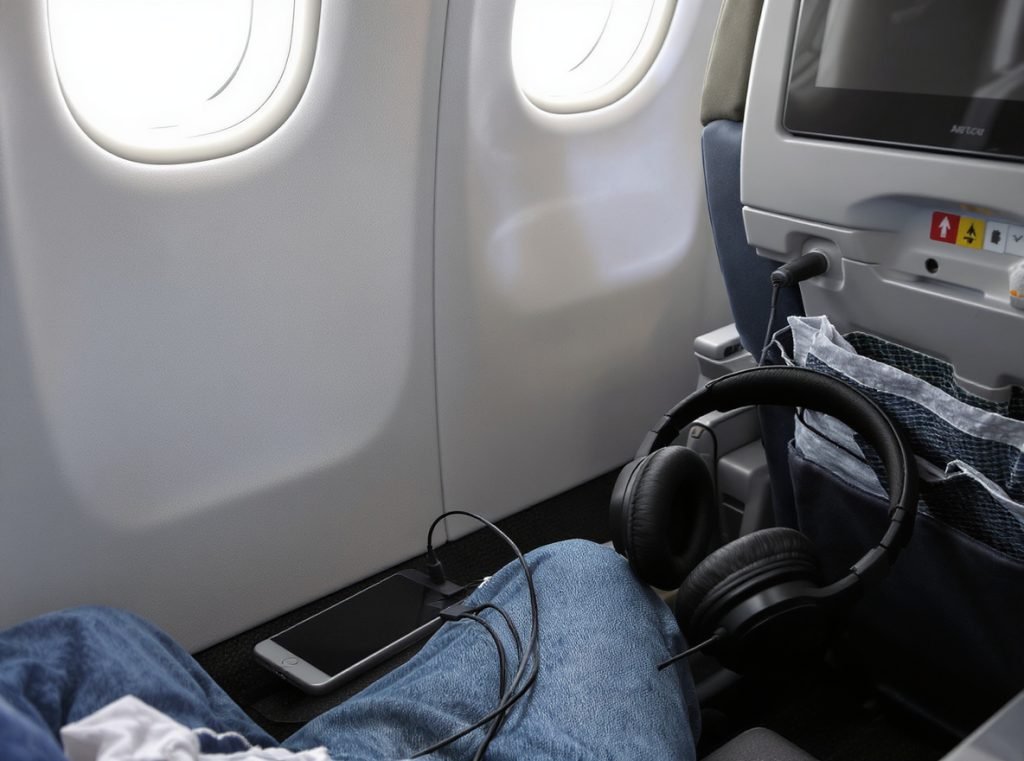
Wireless advantages for travel are substantial. Freedom from cable tangles during sleep, easy movement during layovers, seamless device switching, and elimination of cable snags on armrests or tray tables significantly improve the travel experience.
However, wired connectivity remains essential for several reasons. Many airlines still require traditional aux-jack connections for seat-back entertainment systems. Wired connections also provide superior audio quality through uncompressed transmission and offer unlimited reliability without battery dependency.
Audio latency can affect video watching with wireless connections, though high-quality headphones with low-latency codecs (aptX, AAC) minimize this issue. Wired connections eliminate latency entirely while providing consistent performance in the electronics-heavy airplane environment.
The hybrid approach maximizes flexibility. Premium travel headphones include both Bluetooth wireless capability and a 3.5mm cable, giving you wireless convenience for personal devices while maintaining compatibility with airline systems.
- Wireless eliminates cable management issues during sleep and movement
- Wired backup ensures compatibility with all airline entertainment systems
- Hybrid models provide maximum flexibility for different travel scenarios
- Bluetooth works well for personal devices and modern aircraft systems
- Wired connections offer unlimited reliability and superior audio quality
How Do You Prevent Discomfort During Ultra-Long Flights?
Even the most comfortable headphones require proper usage strategies to maintain comfort during flights exceeding 8-12 hours.
Prevent discomfort through regular 15-minute breaks every 2-3 hours, periodic headband position adjustment, choosing breathable materials like velour or fabric padding, maintaining proper hydration, and avoiding excessive volume levels that cause listener fatigue.
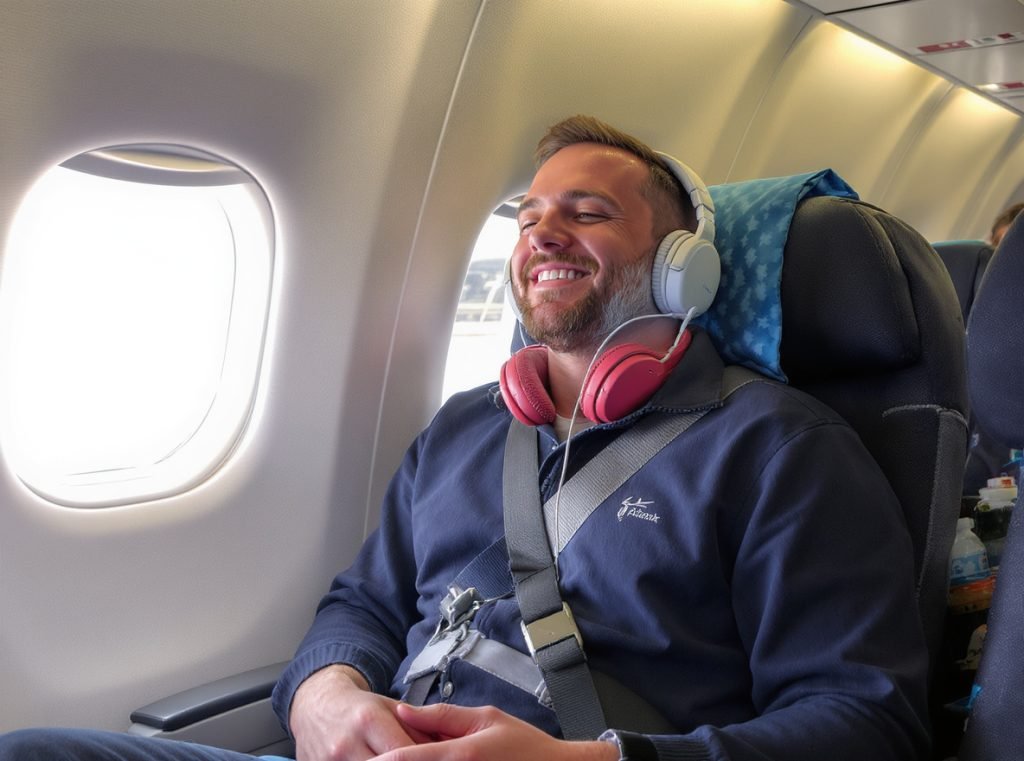
Break scheduling is critical for ultra-long flights. Remove headphones for 10-15 minutes every few hours to restore blood circulation and prevent pressure sore development. This brief break allows your ears and head to recover while preventing heat and moisture buildup.
Proper fit adjustment prevents most discomfort issues. The headband should distribute weight evenly across your head’s crown without creating pressure points. Ear cups should encompass your ears completely without pressing against them, which is particularly important for people with larger ears.
Material selection affects long-term comfort significantly. Breathable materials like velour and fabric-covered foam help prevent heat buildup that makes extended wearing uncomfortable. Avoid synthetic leather if you’re prone to sweating during flights.
Hydration impacts tissue sensitivity throughout your flight. Dehydration, common during air travel, makes skin more sensitive to pressure. Maintaining adequate fluid intake helps preserve comfort and prevents increased sensitivity that develops during long flights.
- Schedule 10-15 minute breaks every 2-3 hours for circulation recovery
- Adjust headband position periodically to redistribute pressure points
- Choose velour or fabric padding over synthetic leather for breathability
- Maintain hydration to preserve skin elasticity and reduce sensitivity
- Use volume limiting to prevent auditory fatigue during extended sessions
What Should You Invest in Quality Travel Headphones?
Understanding price ranges and value propositions helps set realistic expectations and ensures appropriate investment for your travel frequency.
Quality travel headphones range from $79-150 for excellent basic performance, $150-300 for premium features and comfort, and $300-450 for industry-leading technology. Budget-conscious travelers can achieve good results in the $79-150 range, while frequent flyers benefit from investing $200-400 for maximum comfort.
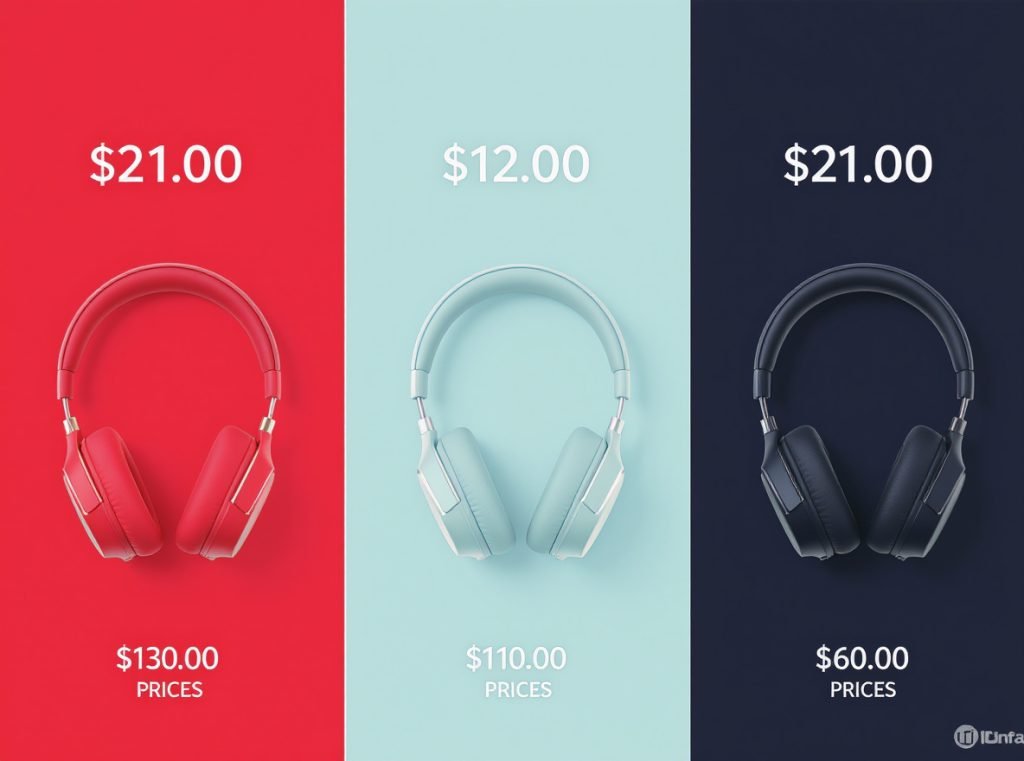
Entry-level excellence ($50-150) provides surprising value. The Anker Soundcore Life Q30 at $79 offers excellent noise cancellation and 40-hour battery life. The EarFun Wave Pro, also $79, provides Hi-Res Audio certification and comfortable memory foam padding with airline compatibility.
Mid-range sweet spot ($150-300) offers the best feature balance. The Bose QuietComfort headphones at $199 provide legendary comfort and excellent noise cancellation. The Sennheiser Momentum 4 at $289 delivers superior sound quality with an impressive 60-hour battery life.
Premium performance ($300-450) maximizes comfort and technology. The Sony WH-1000XM5 at $399 provides industry-leading noise cancellation and smart features. The Bose QuietComfort Ultra at $399 offers spatial audio and premium materials.
Cost-per-use analysis reveals true value. Expensive headphones used weekly for business travel become economical investments, while cheaper options for occasional vacation use provide better value ratios. Quality models lasting 3-5 years often cost less per hour of use than frequently replaced budget alternatives.
| Price Range | Representative Models | Best For | Key Features |
|---|---|---|---|
| $79-150 | Anker Life Q30, EarFun Wave Pro | Occasional travelers | Good ANC, long battery, basic comfort |
| $150-300 | Bose QC, Sennheiser Momentum 4 | Regular travelers | Excellent comfort, premium ANC, 30-60hr battery |
| $300-450 | Sony WH-1000XM5, Bose QC Ultra | Frequent flyers | Industry-leading ANC, luxury materials, smart features |
What Are the Top Recommendations for Different Travel Needs?
Based on extensive testing and user feedback, specific models excel for different travel scenarios and budgets.
Top overall recommendations include the Sony WH-1000XM5 for premium performance, Bose QuietComfort for maximum comfort, Sennheiser Momentum 4 for battery life champions, and Anker Soundcore Life Q30 for exceptional budget value.
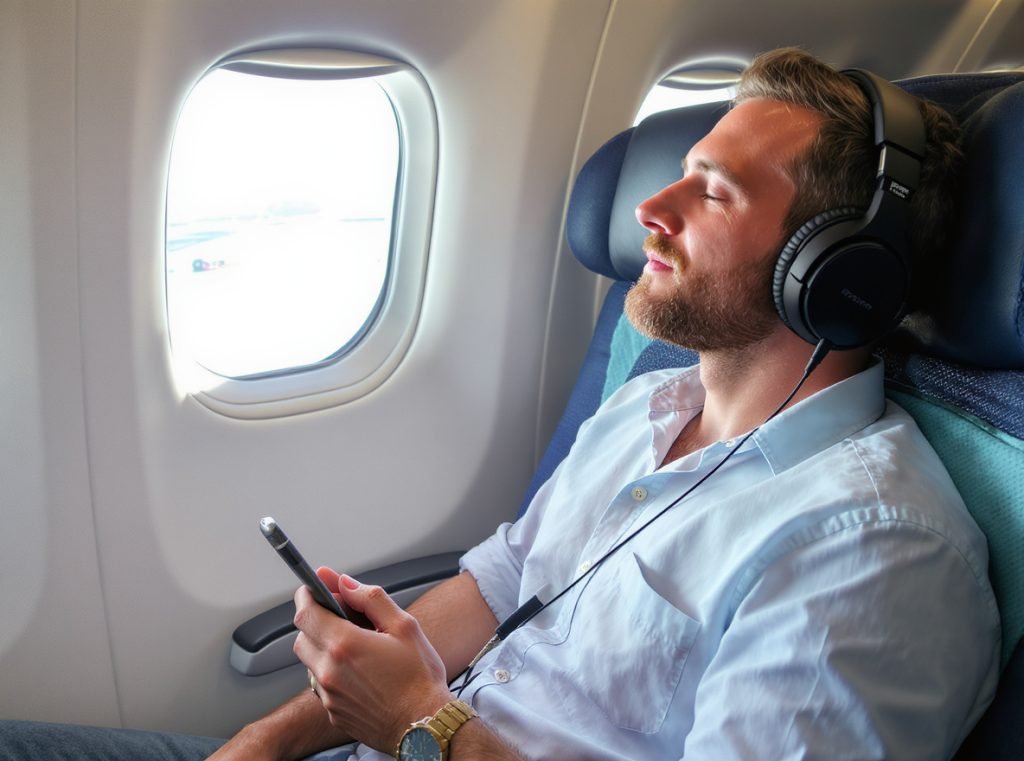
Overall Best for Travel: The Sony WH-1000XM5 at $399 provides industry-leading noise cancellation, 32-hour battery life, excellent sound quality, and premium comfort materials. Advanced features include adaptive noise cancellation and smart connectivity options.
Maximum Comfort Champion: Bose QuietComfort headphones at $199 offer legendary comfort through superior weight distribution and premium padding materials. The lightweight design excels during extended flights while maintaining very good noise cancellation performance.
Battery Life Leader: Sennheiser Momentum 4 at $289 delivers exceptional 60-hour battery life with audiophile-grade sound quality. Premium materials and comfortable design make these ideal for multi-day travel without charging concerns.
Best Value Excellence: Anker Soundcore Life Q30 at $79 provides fantastic noise cancellation, 40-hour battery life, and surprising audio quality. This model offers premium features at budget pricing, perfect for cost-conscious travelers.
Ultra-Comfort Budget Option: The 1MORE SonoFlow at $99 features plush ear pads, good sound quality, and long battery life, making them ideal for travelers prioritizing comfort without premium pricing.
- Sony WH-1000XM5: Premium all-around performance with cutting-edge ANC
- Bose QuietComfort: Maximum comfort and lightweight design for long flights
- Sennheiser Momentum 4: Exceptional 60-hour battery life with audiophile sound
- Anker Soundcore Life Q30: Outstanding value with premium features at $79
- 1MORE SonoFlow: Budget comfort champion with plush padding at $99
How Can Osmarto Support Your Travel Headphone Business Needs?
Finding the right travel headphone solutions for your business requires expert manufacturing partnership and customization capabilities.
Osmarto specializes in manufacturing comfortable, travel-focused headphones for wholesalers, distributors, and retailers worldwide. We offer customizable active noise cancellation technology, extended battery life implementations, premium comfort materials, and competitive wholesale pricing for businesses seeking quality travel headphone solutions.
Our engineering team understands the specific requirements that make headphones truly comfortable for extended travel. We focus on weight optimization under 300 grams, advanced pressure distribution through padded headbands, and premium material selection including memory foam cushions and breathable velour coverings.
Manufacturing capabilities include implementation of advanced ANC technology that achieves 75-85% noise reduction, high-capacity battery systems providing 25-40+ hours of continuous use, and dual connectivity options supporting both wireless and wired operation for airline compatibility.
Quality control processes ensure every headphone meets international comfort and performance standards. Our products undergo extensive testing including 8-12 hour extended wear trials, noise cancellation effectiveness validation, and durability assessment for frequent travel use.
We provide comprehensive business support including technical specifications consultation, market positioning guidance, custom branding options, and ongoing product development assistance. Whether you’re sourcing travel headphone inventory or developing custom solutions, our team delivers expert guidance throughout the process.
Summary
Comfortable travel headphones combine lightweight over-ear design under 300 grams, memory foam cushions, active noise cancellation reducing cabin noise by 75-85%, and 24+ hour battery life to transform long flights into pleasant experiences. The optimal choice includes both wireless convenience and wired backup connectivity for maximum airline compatibility.
Ready to source quality travel headphones for your business? Contact Osmarto today for wholesale pricing, customization options, and expert guidance on selecting the perfect travel headphone solutions that meet your market’s comfort and performance requirements.