Skip to content
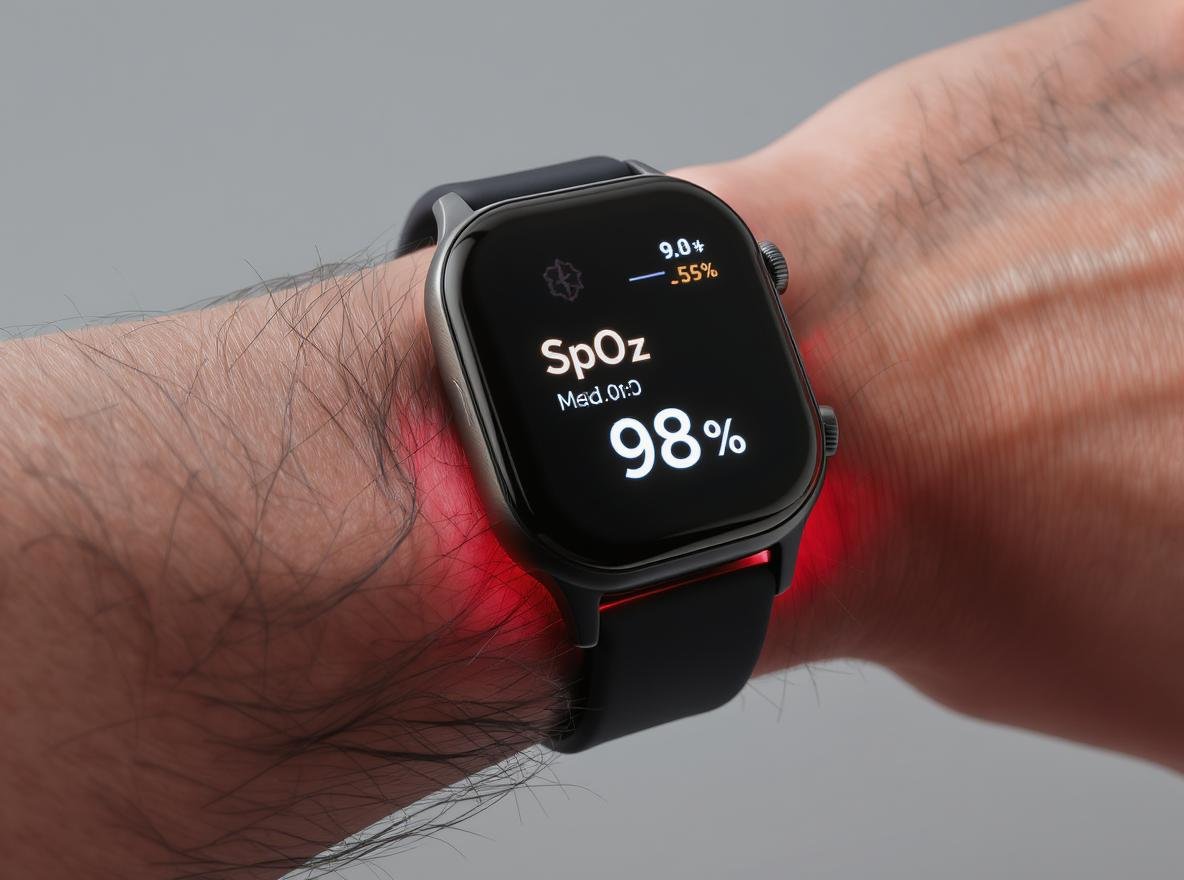
Are you curious about how your smartwatch tracks your blood oxygen levels? Many people wonder whether these tiny wrist devices can really provide accurate health data. The truth is, modern smartwatches use sophisticated photoplethysmography (PPG) technology to monitor your SpO2 levels continuously, bringing hospital-grade pulse oximetry concepts directly to your wrist.
Smartwatches measure blood oxygen (SpO2) levels using reflectance photoplethysmography (PPG) with multi-wavelength LEDs—typically red light (660nm) and infrared light (880-940nm). These lights illuminate capillary beds while photodetectors measure pulsatile light attenuation governed by the Beer-Lambert law, allowing algorithms to compute relative concentrations of oxygenated versus deoxygenated hemoglobin with root-mean-square errors (ARMS) of 2-3% under optimal conditions.
Understanding this technology helps you make informed decisions about health monitoring and choose the right smartwatch solutions for your business needs.
What Is SpO2 and Why Does It Matter for Your Business Customers?
Peripheral oxygen saturation represents one of the most critical vital signs your customers’ bodies produce, making it a valuable feature for health-focused wearable products.
SpO2 (peripheral oxygen saturation) quantifies the percentage of hemoglobin binding sites in arterial blood currently loaded with oxygen. Healthy adults at sea level typically register 95-100%, while values below 90% indicate hypoxemia, risking organ dysfunction if uncorrected.

Your body depends on oxygen for every cellular function. When you breathe, oxygen enters your lungs and binds to hemoglobin in red blood cells, which then carry oxygen throughout your circulatory system.
SpO2 monitoring has become increasingly valuable across multiple market segments:
Healthcare Applications
- Early detection of respiratory issues before symptoms appear
- Remote patient monitoring for chronic conditions like COPD
- Post-surgical oxygen tracking to reduce hospital readmissions
Fitness and Wellness Markets
- Understanding how exercise affects oxygen levels for performance optimization
- Sleep quality monitoring and sleep apnea screening
- Altitude adaptation tracking for outdoor enthusiasts
Corporate Wellness Programs
- Employee health monitoring to reduce healthcare costs
- Occupational safety in high-altitude or industrial environments
- Stress and burnout prevention through physiological tracking
Healthcare professionals have relied on pulse oximetry for decades. Now, smartwatch manufacturers like Osmarto make this technology accessible to consumers worldwide, creating significant opportunities for wholesalers and distributors.
How Does Photoplethysmography (PPG) Technology Work in Smartwatches?
The science behind smartwatch SpO2 measurement relies on proven medical techniques that have been miniaturized and optimized for wearable devices.
Photoplethysmography records beat-to-beat changes in optical density produced by arterial pulse waves. Reflective smartwatch sensors position LED emitters and photodiodes side-by-side on the device back, measuring how blood volume changes affect light absorption during cardiac cycles.

The Technical Process
During systole (heart contraction), arterial volume rises and absorbs more light. During diastole (heart relaxation), volume falls and allows more light reflection. The AC component represents the cardiac pulse, while the DC component reflects static tissue optics.
Multi-Wavelength Analysis
To derive SpO2, smartwatches alternate between red and infrared emissions, measure AC/DC ratios at each wavelength, calculate the “ratio-of-ratios,” and map it to saturation via calibration curves established against arterial blood gas measurements.
Why Red and Infrared, Not Green?
Hemoglobin exhibits distinct absorption spectra: oxyhemoglobin absorbs more infrared light, while deoxyhemoglobin absorbs more red light. Green light (≈525nm) penetrates shallow tissue effectively for heart rate tracking but cannot differentiate between oxygenation states.
Modern Sensor Stack Components
| Component | Function | Advanced Features |
|---|---|---|
| LEDs | Dual- or quad-wavelength packages (660nm, 730nm, 810nm, 940nm) | Auto-gain control, power optimization |
| Photodiodes | Large-area silicon photodetectors | Ambient-light cancellation, high sensitivity |
| Optical Window | Sapphire or polymer lens system | Collimated light delivery, enhanced skin contact |
| Signal Processing | Low-noise amplification and filtering | Motion artifact detection, quality flagging |
This sophisticated approach allows modern smartwatches to achieve clinical-grade accuracy under optimal conditions, making them attractive for both consumer and professional markets.
What Factors Affect Smartwatch SpO2 Accuracy?
Understanding measurement limitations helps businesses set appropriate expectations and educate end users about optimal device usage.
Clinical studies show that physiological variables like skin pigmentation, peripheral perfusion, motion artifacts, and proper device fit significantly impact accuracy. Leading smartwatch models demonstrate ARMS errors of 2-3% under controlled conditions, but real-world performance varies with user demographics and environmental factors.
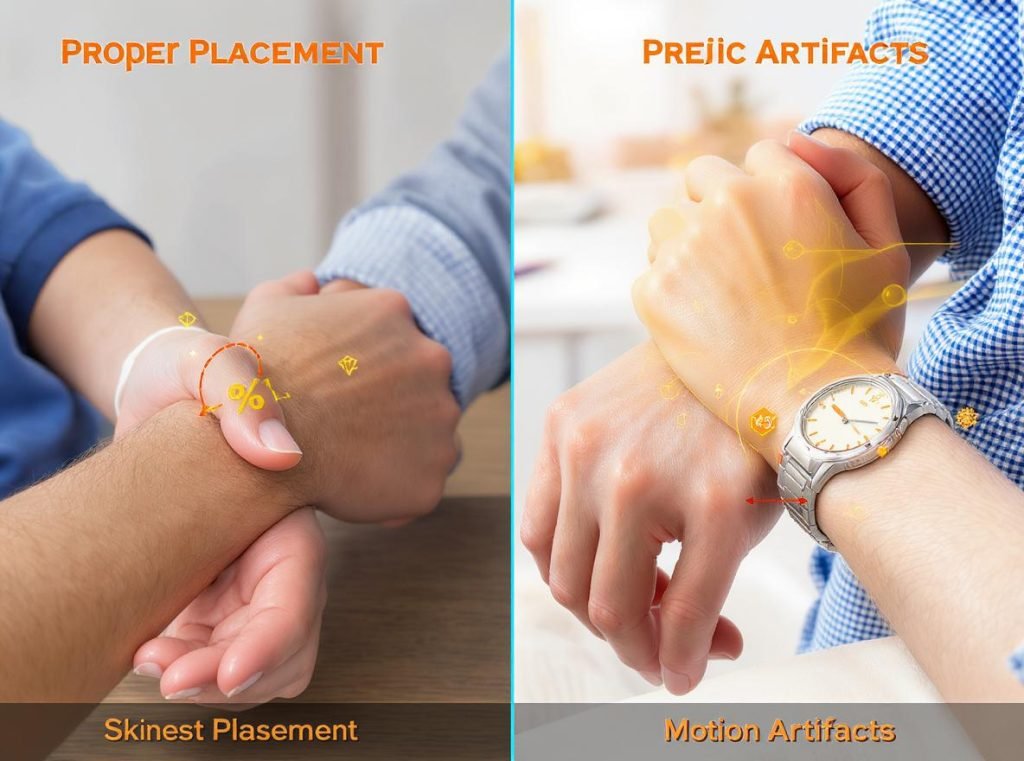
Physiological and Anatomical Variables
Recent research reveals specific accuracy challenges across different user populations:
Skin Pigmentation Effects: The EquiOx ICU study involving 631 patients found that pulse-ox bias varied with spectrophotometer-measured melanin levels. Darker skin showed different average bias patterns, leading to FDA 2025 draft guidance mandating ≥24% of validation subjects across the Monk Skin Tone 7-10 scale.
Perfusion-Related Factors: Low peripheral perfusion from cold temperatures, vasoconstriction, or hypotension reduces AC signal amplitude, leading to measurement dropouts or falsely low readings.
Motion and Environmental Challenges
- Physical Activity: Movement disrupts consistent sensor contact and introduces artifact frequencies
- Ambient Light Interference: Bright sunlight can overwhelm photodetectors
- Temperature Extremes: Cold weather reduces circulation to extremities
- Altitude Changes: Lower atmospheric pressure affects baseline oxygen interpretation
Device-Specific Variables
| Factor | Impact on Accuracy | Mitigation Strategy |
|---|---|---|
| LED Power & Wavelength | ±2-4% variation | Quad-LED modules with auto-gain |
| Photodiode Geometry | ±1-3% improvement | Large area, dual-PD differential sensing |
| Strap Fit | ±3-6% variation | Contoured optical design, fit guidance |
| Algorithm Quality | ±2-5% difference | Machine learning artifact rejection |
Understanding these factors helps businesses recommend appropriate devices for specific use cases and user populations.
How Accurate Are Current SpO2-Enabled Smartwatches?
Real-world validation data from peer-reviewed studies provides concrete accuracy benchmarks for different smartwatch models and use cases.
Leading smartwatch models achieve 74-85% overall correlation with medical-grade devices, with premium models reaching ARMS errors under 3% in controlled settings. However, accuracy varies significantly based on user conditions and device specifications.

Clinical Validation Results
Recent peer-reviewed studies provide specific performance data:
Apple Watch Performance
- Apple Watch Series 8: −0.1 ± 2.2% bias with 95% data success rate
- Apple Watch Series 6 (COPD patients): 0.46 ± 2.78% bias with ARMS 2.8%
- Apple Watch Series 6 (cardio/lung patients): −0.23 ± 1.66% bias with 96% success rate
Competing Device Performance
- Samsung Galaxy Watch 5: −2.6 ± 2.8% bias with 98% success rate
- Garmin Venu 2s: Mean absolute error 5.8% with RMSE 6.7%
- Withings ScanWatch: Mean absolute error 4.3% with RMSE 5.0%
Accuracy by Use Case Scenario
Different measurement conditions yield varying reliability levels:
- Resting measurements: Highest accuracy (80-90% correlation)
- During exercise: Moderate accuracy (70-80% correlation)
- Sleep monitoring: Good accuracy (75-85% correlation)
- Clinical hypoxia detection: Limited reliability (60-75% correlation)
FDA Standards and Medical Compliance
Premium smartwatches using custom optical stacks and FDA-submitted algorithms meet ISO 80601-2-61 ARMS <4% requirements in bench desaturation tests. Mid-tier devices show higher negative bias, especially below 90% saturation, requiring caution for hypoxemia confirmation.
Data Success Rates
Real-world “missingness” (failed measurement attempts) ranges from 5% in optimal laboratory conditions up to 30% in daily life scenarios with motion and environmental interference.
Which Advanced Features Improve SpO2 Measurement Accuracy?
Modern smartwatch technology incorporates multiple enhancements to overcome traditional limitations and improve measurement reliability across diverse user populations.
Multi-LED arrays, advanced signal processing algorithms, accelerometer integration for motion compensation, and adaptive measurement protocols significantly improve smartwatch SpO2 accuracy. Premium devices often include machine learning calibration and skin-tone compensation features for enhanced precision across diverse user demographics.

Hardware Enhancement Technologies
Multi-LED Arrays: Instead of basic dual-LED systems, advanced smartwatches now incorporate up to eight emitters positioned around the sensor array. This approach provides redundant measurements and accounts for skin variations, with devices like the Masimo W1 and Empatica EmbracePlus leading this trend.
3D-Curved Sensor Architecture: Premium models feature contoured optical components that maintain flush skin contact while reducing stray light interference. Apple’s “Crystal Back” design and Garmin’s Elevate 5 sensor stack exemplify this approach.
Enhanced Photodetector Systems: Large-area silicon photodiodes with ambient-light cancellation and dual-photodiode differential sensing improve signal quality, especially in challenging measurement conditions.
Algorithmic Intelligence Features
Modern smartwatches employ sophisticated software enhancements:
Adaptive Perfusion Thresholding: Automatically adjusts integration times and sensitivity based on detected blood flow levels, preventing false readings during low-perfusion states.
Motion Artifact Detection: PPGMotion algorithms detect multi-class motion artifacts with >90% accuracy, suspending SpO2 sampling during vigorous movement to avoid false readings.
Machine Learning Calibration: Newer firmware versions implement personalized mapping updates via transfer learning, with examples like Garmin’s 2025 “Pulse V5” firmware offering user-adaptive calibration.
Premium vs. Standard Model Comparison
| Feature Category | Standard Models | Premium Models | Business Impact |
|---|---|---|---|
| LED Configuration | 2-4 basic LEDs | 6-8+ multi-wavelength | Higher accuracy, broader user compatibility |
| Processing Power | Basic PPG algorithms | AI-enhanced with ML | Reduced false readings, better user experience |
| Calibration Method | Factory presets | User-adaptive learning | Improved long-term accuracy |
| Skin-Tone Support | Limited compensation | Advanced melanin mapping | Broader market appeal, regulatory compliance |
These advanced features create clear differentiation opportunities for businesses targeting premium market segments or specific professional applications.
What Should Users Do When Smartwatches Show Low SpO2 Readings?
Proper response protocols for concerning SpO2 readings help ensure user safety while avoiding unnecessary panic, making this information crucial for customer education and support.
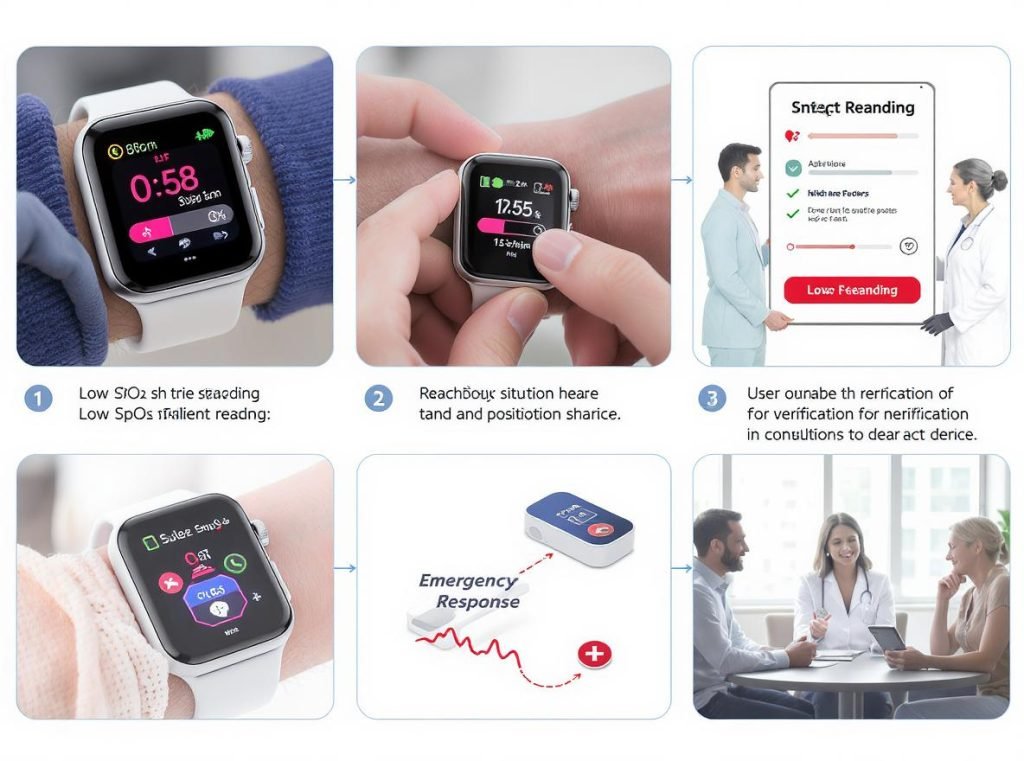
When smartwatch readings consistently show SpO2 below 90%, users should first verify measurements by retaking readings while stationary, then confirm with medical-grade pulse oximetry. Persistent low readings, especially when accompanied by symptoms like breathing difficulties or chest pain, require immediate medical evaluation.
Immediate Verification Steps
Device Repositioning: Remove the smartwatch, clean both sensors and skin, then reposition the device one finger-width above the wrist crease. Ensure snug but not constricting fit, and wait 2-3 minutes in a relaxed, stationary position.
Environmental Optimization: Check for obvious causes like recent intense exercise, cold exposure, or high altitude that might temporarily affect readings. Warm cold extremities to improve peripheral perfusion.
Cross-Validation: When available, use a fingertip pulse oximeter for comparison, as these medical-grade devices typically provide higher accuracy through transmissive rather than reflective measurement methods.
Medical Response Guidelines
| SpO2 Reading | Recommended Action | Clinical Rationale |
|---|---|---|
| 93-94% for >5 minutes | Contact primary care provider | Possible mild hypoxemia requiring evaluation |
| ≤92% at rest | Seek urgent care or emergency services | Below hypoxemic threshold |
| Sudden ≥4% drop during exertion | Schedule provider consultation | May indicate early pulmonary impairment |
| Persistent readings <88% | Immediate emergency care | Severe hypoxemia risk |
Long-Term Management Strategies
Device Optimization: Avoid reflective nail polish or tattoos under the sensor site, as these can interfere with optical measurements. Consider nighttime-only monitoring to exploit motion-free sleep periods where analyzable data success rates exceed 85%.
Trend Analysis: Focus on patterns rather than isolated readings. Nocturnal averages, variability measurements, and frequency of desaturation events correlate with sleep-disordered breathing risk and other health conditions.
Healthcare Integration: Utilize health app connectivity (Apple Health, Google Health Connect, Masimo SafetyNet) to share trend reports with healthcare providers for more informed clinical decision-making.
How Can Businesses Leverage SpO2-Enabled Smartwatches for Growth?
The expanding market for health monitoring technology creates significant opportunities for wholesalers, distributors, and retailers to develop new revenue streams and serve emerging customer needs.
Businesses can capitalize on SpO2-enabled smartwatches through remote patient monitoring services, corporate wellness programs, specialized market applications, and insurance partnerships. The global pulse oximetry market is projected to reach $3.9 billion by 2027, with wearable devices representing the fastest-growing segment.

Healthcare Market Applications
Remote Patient Monitoring (RPM): Healthcare facilities increasingly adopt consumer smartwatches for continuous patient monitoring, especially for chronic conditions like COPD, sleep apnea, and post-surgical recovery. Solutions like Masimo W1 with SafetyNet platform demonstrate 24/7 SpO2 streaming capabilities that reduce hospital readmissions.
Clinical Research Integration: Research institutions utilize aggregated SpO2 data for predictive analytics, with examples including pre-symptomatic COVID-19 detection algorithms achieving 80% sensitivity two days before PCR positivity.
Telehealth Platform Support: Integration with RPM platforms enables healthcare providers to monitor patients remotely, with documented success in tracking 2.8 million vital sign measurements over 14-week periods with 90% synchronization rates.
Corporate and Industrial Markets
Employee Wellness Programs: Companies invest in SpO2-enabled devices to reduce healthcare costs and improve productivity through early health issue detection and stress monitoring.
Occupational Safety Applications: Industries like mining and aviation deploy smartwatches with SpO2 alarms to prevent hypoxia in high-altitude or hazardous environments.
Insurance and Reimbursement Opportunities: Germany’s 2024 Digital-Health statute allows smartwatch-derived oxygen data in official electronic health records, enabling pay-for-prevention insurance models.
Market Segment Analysis
| Market Segment | Applications | Volume Potential | Profit Margins |
|---|---|---|---|
| Healthcare Distributors | Patient monitoring, clinical trials | High volume, consistent demand | Moderate, service-focused |
| Corporate Wellness | Employee programs, safety monitoring | Large bulk orders, contract-based | High, premium features |
| Fitness/Sports Retailers | Performance optimization, training | Medium-high volume, seasonal | Moderate to high |
| Insurance Partnerships | Risk assessment, premium reduction | Volume based on subscriber base | Service revenue sharing |
Partnership Opportunities with Osmarto
As a leading smartwatch manufacturer, Osmarto provides comprehensive solutions for businesses entering the health monitoring market. Our SpO2-enabled devices offer clinically-validated accuracy, competitive wholesale pricing, and extensive customization options for private labeling and specialized applications.
Osmarto’s B2B Advantages:
- FDA-submission ready algorithms meeting ISO 80601-2-61 standards
- Multi-wavelength LED arrays with advanced PPG processing
- Comprehensive API integration for healthcare and corporate platforms
- Skin-tone compensation technology addressing regulatory requirements
- Flexible MOQ terms and rapid prototype development
Our international sales team provides technical training, marketing support materials, and ongoing product development collaboration to ensure your success in this rapidly growing market.
Summary
Smartwatches measure blood oxygen levels using reflectance photoplethysmography with multi-wavelength LEDs and advanced signal processing, achieving ARMS errors of 2-3% under optimal conditions. While excellent for wellness tracking and trend monitoring, users should verify concerning readings with medical-grade devices and seek professional care when appropriate.
Ready to capitalize on the growing health monitoring market? Contact Osmarto today to explore our comprehensive range of SpO2-enabled smartwatches designed for wholesale distribution. Our clinically-validated technology, competitive pricing, and comprehensive business support can help you succeed in this $3.9 billion market opportunity.