
The smartwatch market presents a goldmine for savvy wholesalers and retailers. While Apple dominates with 35% market share and Samsung holds 10%, the remaining 55% creates massive opportunities for value-focused brands that deliver premium features without the premium price tag.
Lesser-known smartwatch brands like Amazfit, Huawei, and emerging players offer 30-70% lower costs than premium alternatives while delivering 80-90% of flagship functionality, creating exceptional profit margins of 30-60% for wholesale buyers compared to just 15-25% from established brands.
Smart wholesalers are capitalizing on this fragmented market to build profitable businesses around high-value alternatives.
What Makes a Smartwatch Brand “Lesser-Known” But Valuable?
Understanding value in today’s smartwatch landscape goes far beyond brand recognition. The most profitable opportunities often lie with manufacturers who prioritize functionality over marketing budgets.
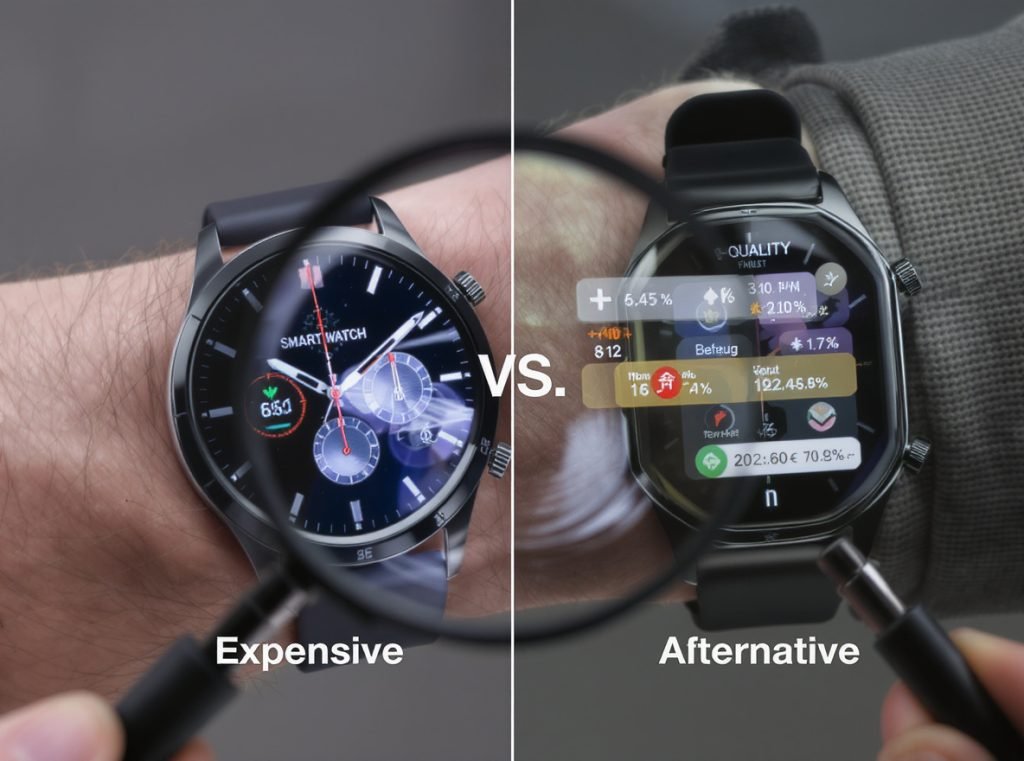
Lesser-known brands achieve superior value through direct manufacturing partnerships, focused feature development, and strategic pricing that delivers 80-90% of premium functionality at 30-70% lower wholesale costs.
These brands distinguish themselves through several key characteristics:
Market positioning outside the Apple-Samsung-Garmin ecosystem allows flexible pricing and feature innovation. Many operate with lower overhead costs and direct-to-consumer models, enabling superior profit margins for wholesalers while maintaining competitive retail pricing.
Innovation focus on practical features rather than marketing campaigns often results in cutting-edge technology implementation before major brands adopt them in mass market devices. Battery optimization, health sensor accuracy, and build quality improvements happen faster in this segment.
Manufacturing advantages through established supply chains mean many lesser-known brands produce devices in the same facilities as premium competitors but allocate resources differently:
• Research and development focused on core user benefits
• Efficient manufacturing processes reducing production costs
• Direct distribution models eliminating middleman markups
• Flexible minimum order quantities for testing new markets
The result is exceptional wholesale opportunities with devices that satisfy demanding consumers while generating healthy profit margins for retailers and distributors.
Which Amazfit Models Deliver the Best ROI for Wholesalers?
Amazfit has evolved into the third-largest smartwatch vendor globally, making it technically no longer “lesser-known” but still offering exceptional value compared to premium alternatives for wholesale buyers.
The Amazfit Active 2 ($99 retail), Bip 6 ($80 retail), and Balance ($149 retail, down from $199) provide the highest wholesale margins while delivering comprehensive health tracking, 14-day battery life, and premium build quality that competes directly with devices costing 2-3 times more.
Amazfit’s wholesale appeal extends beyond individual model pricing. Their ecosystem approach includes consistent firmware updates that maintain device relevance, wide iOS and Android compatibility expanding potential customer base, and proven reliability with battery performance exceeding most competitors.
Key Amazfit wholesale advantages:
| Model | Retail Price | Key Features | Wholesale Appeal |
|---|---|---|---|
| Active 2 | $99 | 14-day battery, comprehensive health tracking | High turnover, broad market appeal |
| Bip 6 | $80 | Ultra-affordable premium features | Entry-level market dominance |
| Balance | $149 | Advanced fitness metrics, AI coaching | Health-focused consumer targeting |
The Amazfit advantage for wholesale buyers includes established market presence reducing customer education requirements, proven product reliability minimizing warranty issues, and consistent software support maintaining long-term customer satisfaction.
Their devices appeal to multiple demographics while maintaining healthy profit margins that allow competitive retail pricing and promotional flexibility.
How Do Chinese Brands Like Huawei and Xiaomi Compare to Western Alternatives?
Chinese smartwatch manufacturers have revolutionized the value proposition in the global market, creating unprecedented opportunities for wholesale buyers seeking competitive advantages.
Chinese brands like Huawei and Xiaomi deliver equivalent build quality, superior battery performance, and comparable health tracking accuracy at 40-60% lower wholesale costs than Western alternatives, while offering significantly better profit margins for retailers.
The technology and quality gap between Chinese and Western smartwatch brands has virtually disappeared, with Chinese manufacturers often leading in specific areas:
Huawei Watch GT 5 offers advanced fitness tracking, temperature sensors, and Bluetooth heart rate strap support at $200-250 retail, competing directly with $400-500 Western alternatives. The wholesale pricing structure allows 45-55% margins compared to 20-30% for premium Western brands.
Xiaomi Watch S4 features 1,500-nit brightness displays, interchangeable bezels, and NFC payment integration at $150-200 retail. The build quality matches premium competitors while wholesale costs remain 50-60% lower.
Competitive analysis for wholesale consideration:
Battery performance consistently favors Chinese brands with 10-28 day battery life compared to 1-7 days for Western alternatives. This extended performance reduces customer complaints and return rates while providing strong selling points for retail staff.
Health tracking accuracy now matches Western competitors through advanced sensor technology and AI coaching integration. Many Chinese brands implement ChatGPT-powered fitness recommendations and personalized health insights previously exclusive to premium devices.
Build quality improvements include premium materials, comprehensive waterproofing, and scratch-resistant displays that meet or exceed Western brand standards. Manufacturing expertise gained from producing components for premium Western brands translates into superior end-product quality.
Software ecosystem development continues improving with regular updates and expanding feature sets, though Western brands maintain advantages in long-term support and integration with existing smartphone ecosystems.
What Emerging Brands Are Gaining Market Traction in 2025?
The smartwatch landscape continues evolving with innovative new players entering the market through aggressive pricing and unique feature positioning that creates fresh wholesale opportunities.
Nothing’s CMF Watch 3 Pro ($99), OnePlus Watch 3 ($329), and Redmi Watch 5 ($110) represent emerging brands gaining significant market traction through premium features at disruptive price points, offering wholesale margins of 40-60% compared to established alternatives.

Nothing CMF Watch 3 Pro represents exceptional wholesale value at $99 retail pricing:
Dual-band GPS with five-system positioning accuracy typically found in $300+ devices. AI coaching powered by ChatGPT integration providing personalized fitness recommendations. 13-day battery life with IP68 water resistance matching premium competitor specifications. Four-channel heart rate sensor delivering improved accuracy over standard implementations.
OnePlus Watch 3 targets premium market positioning at $329 retail:
Functional rotating crown and ECG capabilities competing directly with Apple Watch functionality. Titanium bezel construction with premium materials justifying higher price points. Advanced health monitoring suite comparable to flagship devices from established brands.
Note: Recent tariff impacts have increased pricing to $499 in some markets, affecting wholesale viability and requiring pricing strategy adjustments.
Redmi Watch 5 delivers exceptional value at $110 retail:
2.07-inch AMOLED display with 1,500-nit brightness exceeding many premium competitors. 150+ sports modes with advanced fitness tracking appealing to active consumer segments. Premium aluminum construction providing durability and aesthetic appeal.
Geographic market considerations for emerging brands:
European consumers show higher acceptance of Chinese and emerging brands, creating stronger wholesale opportunities in these markets. North American markets still favor established names but show growing openness to value alternatives when properly positioned.
For wholesale buyers, emerging brands offer several strategic advantages including lower minimum order quantities for market testing, flexible partnership terms as brands build distribution networks, and opportunities to establish exclusive regional partnerships before mainstream adoption.
What Features Should Wholesalers Prioritize When Selecting Value Brands?
Success in the value smartwatch market requires focusing on features that deliver measurable user benefits rather than specifications that inflate costs without adding practical value for end consumers.
Prioritize battery life exceeding 7 days, accurate health sensors with AI coaching integration, water resistance IP68 or higher, and dual-band GPS positioning for maximum market appeal and reduced customer support issues.
Essential features driving consumer satisfaction and repeat business:
Battery performance directly impacts user experience and review ratings. Devices requiring daily charging generate negative customer feedback and increase return rates. Target minimum 7-day battery life under normal usage conditions, with 14+ day capability providing competitive differentiation.
Health tracking accuracy builds brand credibility and justifies premium positioning over basic fitness trackers. Focus on brands implementing FDA-approved or medically validated sensors for heart rate, blood oxygen, and sleep monitoring.
Advanced feature prioritization for wholesale success:
| Priority Level | Feature Category | Minimum Requirement | Premium Advantage |
|---|---|---|---|
| Critical | Battery Life | 7+ days | 14+ days with power saving modes |
| Critical | Health Sensors | Heart rate, steps, sleep | SpO2, ECG, stress monitoring |
| High | Water Resistance | IP68 swimming capability | Advanced water sports tracking |
| High | GPS Accuracy | Dual-band positioning | Five-system satellite support |
| Medium | Smart Features | Notifications, voice assistant | NFC payments, cellular connectivity |
AI-powered coaching represents the fastest-growing feature category, with brands implementing ChatGPT integration and personalized fitness recommendations commanding 20-30% higher retail margins. This technology differentiates value brands from basic fitness trackers while justifying premium pricing.
Build quality factors affecting long-term profitability:
Scratch-resistant displays using Gorilla Glass or equivalent reduce warranty claims and customer dissatisfaction. Reliable charging connections maintaining integrity over extended use prevent common failure points that generate negative reviews.
Smart feature implementation should enhance rather than complicate user experience through intuitive notification management, accurate voice assistant integration, and seamless smartphone connectivity across iOS and Android platforms.
What Are the Profit Margin Advantages of Lesser-Known Brands?
Understanding profit potential helps wholesalers make informed inventory decisions and pricing strategies in the competitive smartwatch market landscape.
Lesser-known smartwatch brands typically offer 30-60% wholesale profit margins compared to 15-25% for premium brands, with wholesale costs ranging from $40-120 for devices retailing competitively at $80-299, creating substantial revenue opportunities for businesses.

Profit structure analysis by brand category:
Premium brands (Apple, Samsung) maintain strict Minimum Advertised Price (MAP) policies limiting wholesale margins to 15-25%. High wholesale costs and pricing restrictions reduce competitive flexibility and promotional opportunities.
Lesser-known brands offer 30-50% wholesale margins with flexible pricing policies allowing aggressive retail positioning, promotional pricing, and bundle strategies. Greater inventory turnover potential through competitive pricing while maintaining healthy profit margins.
Direct Chinese suppliers can provide 40-60% margins with higher minimum order quantities, though require more significant inventory investment and longer lead times.
Real-world wholesale profit examples:
Sample order quantities (1-10 units) typically available at 20-30% margins for market testing purposes. Small wholesale orders (100-500 units) achieve 35-45% margins with established supplier relationships. Bulk orders (1000+ units) reach 45-60% margins with potential OEM customization options.
Additional profit considerations beyond initial margins:
Warranty and support costs remain lower for value brands due to fewer complex features prone to failure. Higher inventory turnover rates often exceed premium brands due to attractive consumer pricing. Cross-selling opportunities with accessories, extended warranties, and replacement bands generate additional revenue streams.
Volume tier optimization for maximum profitability:
Lower minimum order quantities allow testing new markets without significant capital investment. Flexible partnership terms enable exclusive regional distribution agreements. Access to innovative features before mainstream adoption provides competitive advantages.
The key to maximizing profitability lies in strategic positioning emphasizing value proposition through feature comparisons rather than competing solely on price, maintaining healthy margins while building consumer confidence in lesser-known brands.
How Can Retailers Successfully Market Lesser-Known Smartwatch Brands?
Successfully marketing value-oriented smartwatch brands requires strategic positioning that emphasizes functionality and measurable benefits rather than competing directly on brand recognition with established players.
Focus marketing efforts on detailed feature comparisons, customer testimonials, and hands-on demonstrations that allow customers to experience quality and performance firsthand, while positioning devices as “premium alternatives” rather than “budget options” to maintain perceived value.
Effective marketing strategies for value smartwatch brands:
Comparison-focused marketing works exceptionally well for lesser-known brands by clearly demonstrating value propositions. Create detailed side-by-side comparisons highlighting how products match or exceed premium brand features at substantially lower prices.
Feature specification tables demonstrating superior battery life, health tracking accuracy, and build quality compared to established alternatives. Real-world performance demonstrations showing actual device operation, battery performance, and health monitoring capabilities.
Customer education builds confidence in unfamiliar brands through comprehensive product information addressing common quality and reliability concerns. Video demonstrations showing interface navigation, feature operation, and long-term performance build trust with potential customers.
Digital marketing tactics delivering results for lesser-known brands:
Social media campaigns featuring authentic user experiences and comparative reviews generate organic engagement. Influencer partnerships with fitness and tech enthusiasts provide credible third-party validation of product quality and performance.
Search engine optimization targeting “Apple Watch alternatives” and “Samsung Galaxy Watch competitors” with value-focused landing pages captures high-intent purchase traffic. Content marketing explaining smartwatch technology and feature benefits educates consumers while building brand authority.
Community building approaches enhance long-term customer relationships:
Fitness challenges implemented through companion apps encourage user engagement and social sharing. Superior customer service excellence provides differentiation against larger brands with limited support access. User-generated content featuring real customer experiences builds authentic social proof.
Strategic retail positioning maintaining premium perception:
Position as “smart alternatives” emphasizing specific advantages like extended battery life or specialized features rather than generic “cheaper options.” Create bundle packages adding value while maintaining profit margins through accessories and extended warranties.
Point-of-sale materials highlighting key differentiators and value propositions support retail staff in articulating benefits effectively. Staff training programs ensure consistent messaging about product advantages and competitive positioning.
Summary
Lesser-known smartwatch brands deliver exceptional wholesale opportunities through focused innovation, efficient manufacturing, and strategic pricing that benefits both consumers and business buyers. Brands like Amazfit (now third globally), Chinese manufacturers Huawei and Xiaomi, and emerging players like Nothing’s CMF offer 30-60% better profit margins while delivering equivalent functionality including extended battery life, accurate health monitoring, and premium build quality. Success requires strategic positioning emphasizing value propositions through feature comparisons, customer education, and hands-on demonstrations rather than competing on brand recognition alone.

Ready to capitalize on the profitable smartwatch wholesale market? Contact Osmarto today to explore our comprehensive range of high-value smartwatch solutions designed for today’s competitive landscape. Our experienced team specializes in helping wholesalers, distributors, and retailers identify the perfect products for their customer base while maximizing profit potential in this rapidly growing market.