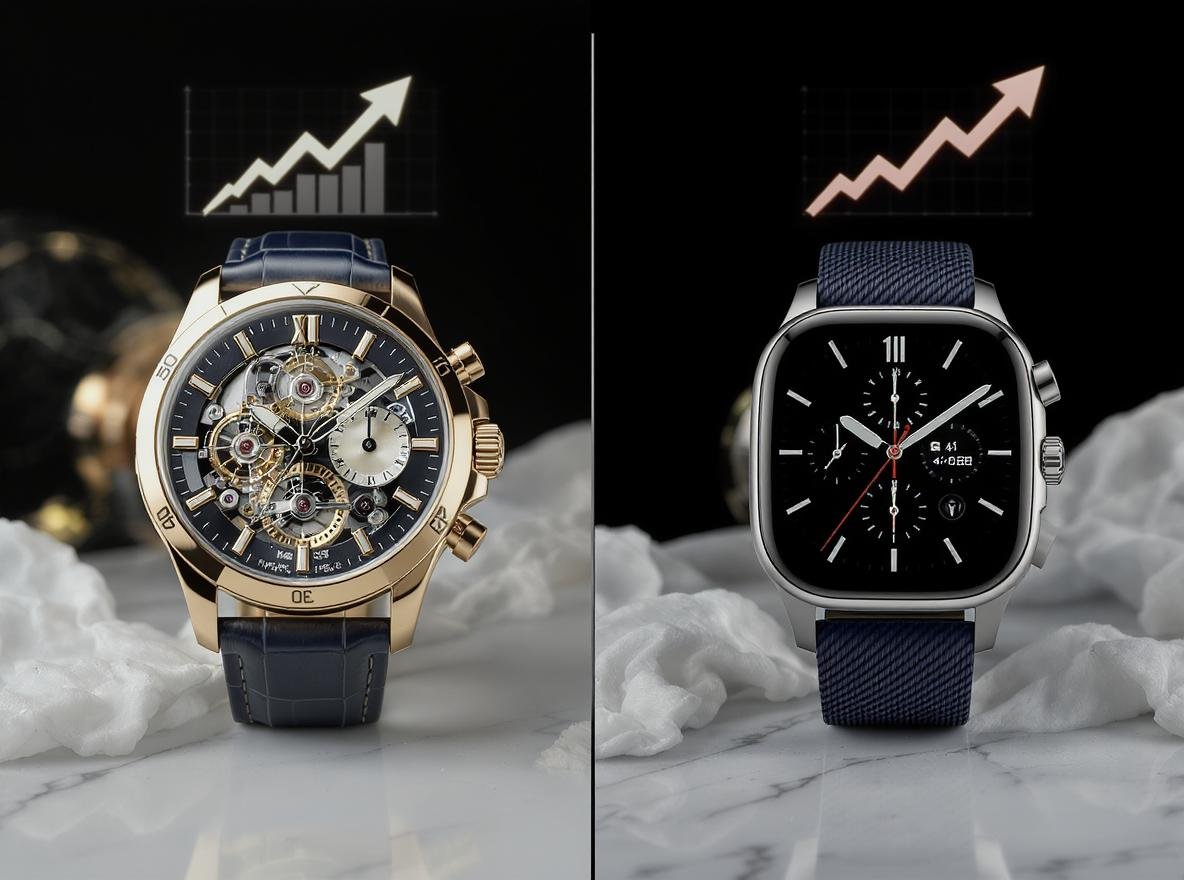
You’re facing a critical investment decision: a cutting-edge luxury smartwatch or a timeless traditional timepiece. Both carry premium price tags, but only one consistently protects and grows your wealth. This choice determines not just your style statement, but your financial future.
Traditional luxury watches consistently outperform smartwatches as investments, delivering 9% compound annual returns over the past decade while luxury smartwatches depreciate 40-98% within 2-3 years. Established brands like Rolex and Patek Philippe appreciate 20% annually, significantly outpacing both smartwatches and traditional financial markets like the S&P 500.
Understanding the fundamental differences between these investment vehicles could save you thousands while building lasting wealth through wearable assets.
What Makes Traditional Luxury Watches Strong Investment Assets?
Traditional luxury watches have established themselves as legitimate alternative investments with decades of proven performance data. The investment case extends far beyond mere timekeeping into the realm of tangible assets with remarkable appreciation potential.
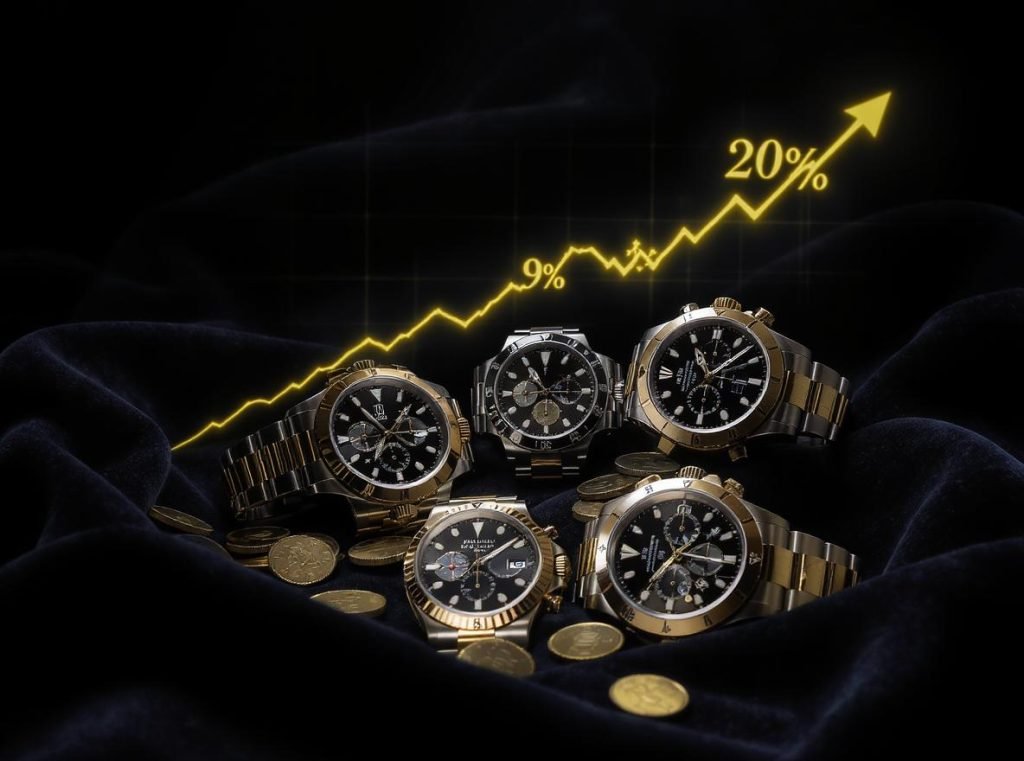
Traditional luxury watches delivered compound annual returns of 9% over the past 10 years, outperforming vintage cars (118% total growth), art, and diamonds. Specific brands show even stronger performance—Rolex, Patek Philippe, and Audemars Piguet watches appreciated by an average of 20% annually from mid-2018 to January 2023, significantly outpacing the S&P 500’s 8% returns during the same period.
The luxury watch market reached $53.69 billion in 2024 and projects growth to $134.53 billion by 2032, exhibiting a 12.23% compound annual growth rate. This robust expansion reflects sustained global demand for mechanical timepieces as investment vehicles.
Key Performance Drivers:
- Brand heritage creates lasting value: Century-old manufacturers command premium positioning
- Deliberate scarcity drives appreciation: Patek Philippe produces only 70,000 watches annually, Audemars Piguet manufactures just 26,000 pieces yearly
- Exceptional stability: Luxury watches demonstrate the lowest volatility among asset classes at 3.90% annual volatility, compared to 5-8% for fixed income investments
- Low market correlation: Minimal correlation to traditional financial markets provides portfolio diversification benefits
Record-Breaking Appreciation Examples:
The Patek Philippe Nautilus Ref. 5711 originally retailed for $30,000-$38,000 but traded over $100,000 in secondary markets before discontinuation. Some vintage Rolex models show even more dramatic gains—a GMT Master II costing $3,000 twenty years ago now sells for approximately $13,000.
Investment Performance Comparison:
| Watch Category | Average Annual Return | 5-Year Appreciation | Volatility |
|---|---|---|---|
| Rolex Sports Models | 12-20% | 150-300% | 3.2% |
| Patek Philippe | 15-25% | 200-400% | 4.1% |
| Audemars Piguet | 10-18% | 120-250% | 3.8% |
| Traditional Markets (S&P 500) | 8-10% | 40-60% | 15-20% |
How Do Luxury Smartwatches Perform as Investment Assets?
Luxury smartwatches present a fundamentally different investment proposition, characterized by rapid technological obsolescence that severely undermines long-term value retention potential.
Luxury smartwatches experience dramatic depreciation, losing 40-98% of their value within 2-3 years due to technological advancement cycles. The first-generation Apple Watch, launched at $349 in April 2015, averaged around $160 on secondary markets by 2017—a 55% value loss in under two years. The premium Apple Watch Edition, originally priced at $10,000, sold for approximately $200 on eBay, representing a 98% value destruction.
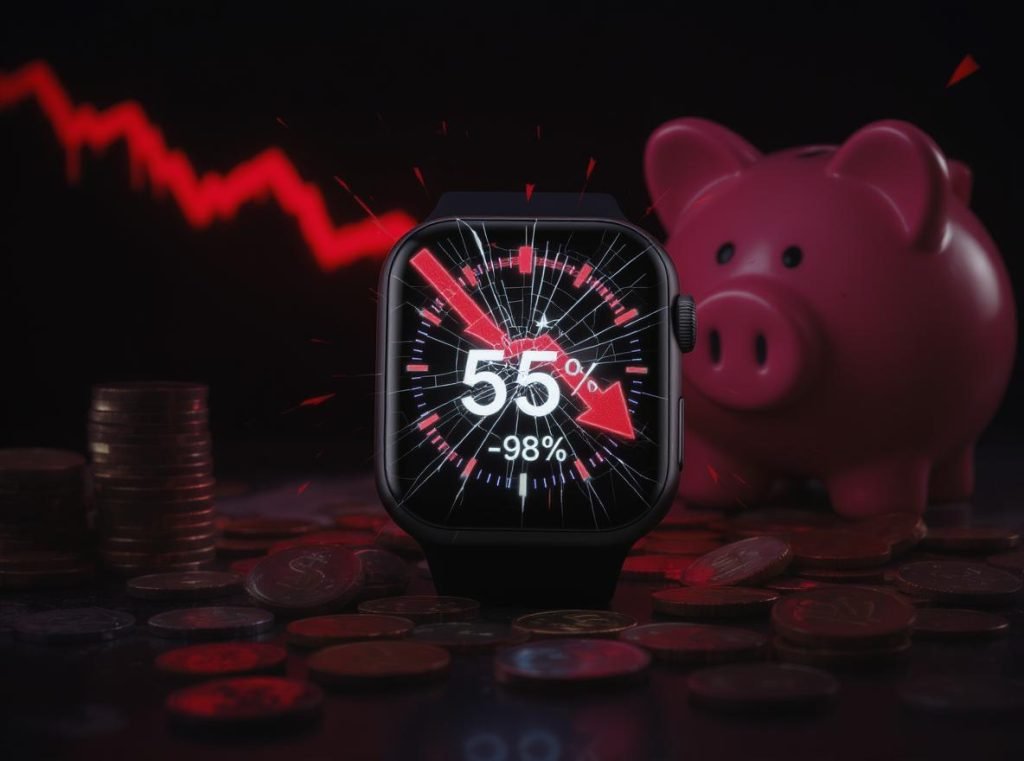
Even established technology brands struggle with smartwatch value retention. The Samsung Galaxy Gear depreciated 82.5% over three and a half years, while Pebble devices became worthless after the company’s acquisition.
Core Depreciation Factors:
- Annual product cycles: New models with enhanced features emerge yearly
- Software obsolescence: Operating system support typically ends within 3-5 years
- Battery degradation: Lithium batteries lose capacity, reducing functionality over time
- Connectivity dependence: Older models lose smartphone compatibility as technology advances
- Rapid feature evolution: Health sensors and processing power improvements make previous generations obsolete
Market Growth vs. Individual Performance:
While the global smartwatch market projects dramatic growth—from $60.56 billion in 2024 to $477.1 billion by 2033 at 25.78% compound annual growth rate—this expansion benefits manufacturers rather than device owners. Market growth actually accelerates individual device obsolescence as new capabilities emerge.
Depreciation Timeline Analysis:
| Time Period | Apple Watch | Samsung Galaxy | Premium Smartwatches |
|---|---|---|---|
| Year 1 | -20% to -30% | -25% to -35% | -30% to -40% |
| Year 2 | -40% to -55% | -50% to -65% | -60% to -80% |
| Year 3-5 | -70% to -90% | -80% to -95% | -90% to -98% |
What Factors Determine Long-Term Value Retention?
Understanding the fundamental drivers of value retention reveals why traditional luxury watches consistently outperform smartwatches as investment vehicles across multiple time horizons and market conditions.
Brand reputation, production scarcity, mechanical complexity, and historical significance primarily determine long-term value retention for traditional watches. These timepieces benefit from established heritage spanning decades or centuries, while smartwatches face uncertainty due to recent market emergence and technology dependence that creates predictable obsolescence patterns.
Traditional Watch Value Drivers:
Brand reputation remains paramount for investment performance. Established manufacturers like Rolex maintain consistent recognition while Patek Philippe’s innovation reputation creates lasting demand that supports secondary market values.
Scarcity multiplies appreciation potential:
- Limited production runs create natural demand pressure
- Discontinued models often see 50-200% price increases
- Special editions command substantial premiums over standard models
- Vintage pieces from defunct manufacturers become increasingly rare
Mechanical complexity adds investment appeal:
- Complications like perpetual calendars increase manufacturing difficulty
- Tourbillons and minute repeaters demonstrate technical mastery
- Hand-finished movements justify premium pricing
- Independent movement development creates brand differentiation
Material composition influences retention:
Traditional luxury watches utilize precious metals, gemstones, and exotic materials retaining intrinsic commodity value. Gold, platinum, and diamond components provide value floors even during market downturns.
Smartwatch Value Challenges:
Smartwatches face fundamentally different value dynamics that work against long-term appreciation:
Technology dependence creates obsolescence:
- Software support discontinuation after 3-5 years renders devices partially functional
- Battery replacement costs often exceed device resale value
- Processor improvements make older models noticeably slower
- New health sensors provide capabilities unavailable in previous generations
Mass production eliminates scarcity:
- Manufacturing scales focus on volume rather than exclusivity
- No artificial production limitations create scarcity premium
- Technology commoditization pressures pricing downward
- Limited edition releases lack mechanical complexity justifying premiums
Value Retention Comparison:
| Factor | Traditional Luxury Watches | Luxury Smartwatches |
|---|---|---|
| Heritage Timeline | 50-200+ years established | 5-15 years maximum |
| Production Philosophy | Intentionally limited | Mass production focused |
| Material Value | High precious metal content | Minimal commodity value |
| Functional Lifespan | Decades with maintenance | 2-5 years typical |
| Repair Ecosystem | Established service networks | Limited post-warranty support |
Which Investment Strategy Suits Different Buyer Profiles?
Investment approach should align with individual financial goals, risk tolerance, and time horizons. Different buyer profiles benefit from distinct strategies when navigating luxury timepiece markets.
Conservative wealth preservers should prioritize established traditional luxury watch brands with proven appreciation histories. Technology enthusiasts accepting depreciation for cutting-edge features may consider luxury smartwatches worthwhile, but should treat them as consumable technology rather than investment vehicles requiring different financial planning approaches.
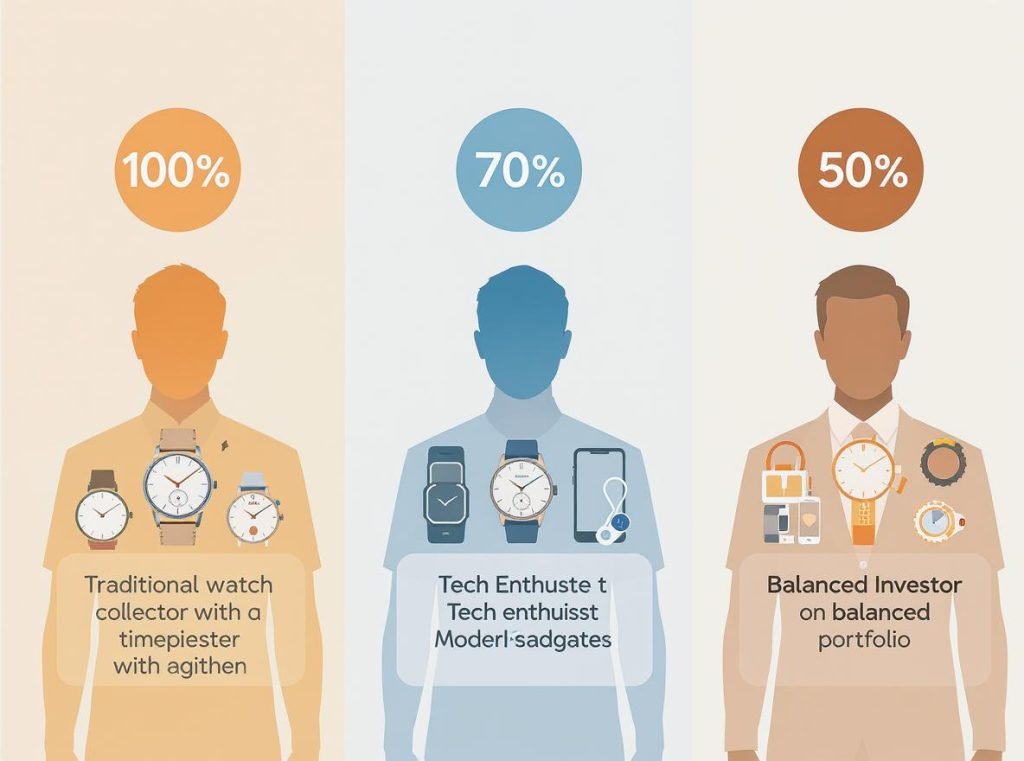
Conservative Wealth Preservation Strategy:
Focus on blue-chip watch brands with demonstrated long-term appreciation. Rolex sports models, Patek Philippe complications, and vintage Omega Speedmasters provide the strongest investment foundations.
- Recommended allocation: 90-100% traditional luxury watches
- Risk profile: Low to moderate volatility
- Investment horizon: 10+ years optimal
- Expected returns: 8-15% annually based on historical data
- Liquidity: Strong secondary markets provide exit opportunities
Technology-Forward Approach:
Accept depreciation in exchange for advanced functionality and connectivity features. View luxury smartwatches as premium electronics providing utility value rather than financial returns.
- Recommended allocation: Maximum 20% of luxury watch budget
- Risk profile: High depreciation certainty
- Ownership cycle: 2-3 years before technology obsolescence
- Expected returns: -40% to -80% depreciation expected
- Utility focus: Health monitoring, connectivity, convenience features
Diversified Collection Strategy:
Balance heritage timepieces with select modern technology pieces, treating each category separately within overall financial planning frameworks.
Strategic Portfolio Allocation:
| Investor Profile | Traditional Watches | Luxury Smartwatches | Investment Rationale |
|---|---|---|---|
| Pure Investor | 100% | 0% | Maximum appreciation focus |
| Conservative Collector | 85% | 15% | Balanced growth with modern utility |
| Technology Enthusiast | 70% | 30% | Functionality with some preservation |
| Fashion Consumer | 50% | 50% | Style focus over investment returns |
How Do Market Trends Affect Future Investment Potential?
Current market dynamics suggest diverging trajectories for traditional and smart luxury watches, with fundamental trends reinforcing the investment case for mechanical timepieces while highlighting smartwatch limitations.
Traditional luxury watches show strengthening investment fundamentals as younger generations discover mechanical craftsmanship appreciation, while smartwatch markets mature toward commodity pricing despite premium positioning attempts. The pre-owned luxury watch market, valued at $24.38 billion in 2023, could reach $45.01 billion by 2030, validating watches as legitimate investment assets.
Emerging Positive Trends for Traditional Watches:
Millennial and Gen Z interest: Younger demographics increasingly appreciate mechanical craftsmanship as digital fatigue grows. Social media exposure to vintage and heritage pieces drives discovery of traditional watchmaking artistry.
Sustainable luxury preference: Growing environmental consciousness favors repairable, generational luxury goods over disposable technology products requiring regular replacement.
Emerging market expansion: China and India represent significant growth opportunities as wealth increases and luxury goods interest expands in previously underserved markets.
Independent brand recognition: Collectors increasingly appreciate smaller manufacturers like F.P. Journe and Laurent Ferrier, creating new investment opportunities beyond traditional established names.
Smartwatch Market Maturation Challenges:
Commoditization pressure: Technology standardization reduces differentiation between brands, pressuring pricing toward commodity levels rather than luxury premiums.
Accelerating replacement cycles: Annual product improvements create shorter ownership periods, reducing individual device value retention potential.
Market saturation effects: As adoption rates increase, growth shifts from premium segments toward mass market pricing pressure.
Future Market Projections:
| Category | 5-Year Growth Outlook | Investment Viability | Primary Value Drivers |
|---|---|---|---|
| Traditional Luxury | Continued 8-12% annual appreciation | High confidence | Heritage, scarcity, craftsmanship |
| Luxury Smartwatch | Rapid individual depreciation | Very low | Technology utility, not investment |
| Hybrid Technology | Uncertain viability | Moderate risk | Unproven integration challenges |
What Role Should Osmarto Play in Your Investment Strategy?
As a smart watch manufacturer, Osmarto operates within the competitive technology segment rather than traditional luxury investment markets. Understanding this positioning clarifies appropriate expectations and strategic applications.
Osmarto smartwatches should be evaluated based on technology features, build quality, and competitive pricing rather than investment potential. Like all smartwatches, Osmarto devices will experience rapid depreciation following technology industry patterns, making them suitable for utility-focused purchases rather than wealth preservation strategies.

Osmarto’s Strategic Market Position:
Osmarto competes in the mid-range to premium smartwatch segment, facing the same fundamental investment challenges as major technology brands while potentially offering superior value propositions for specific use cases.
Competitive Advantages for Wholesale Partners:
- Cost-effective manufacturing: Direct factory pricing enables competitive retail margins
- Customization capabilities: Flexible production runs accommodate specific market requirements
- Premium materials: Access to titanium, ceramic, and sapphire crystal options
- Advanced feature integration: Health monitoring, GPS, and extended battery life
- Quality assurance: ISO certification and rigorous testing protocols
B2B Wholesale Opportunities:
Market positioning strategy: Position Osmarto smartwatches as premium technology accessories complementing traditional luxury watch offerings rather than competing directly with investment-grade timepieces.
Target customer segments:
- Technology enthusiasts seeking advanced features at competitive prices
- Fitness-focused consumers prioritizing health monitoring capabilities
- Business professionals requiring connectivity and productivity features
- Gift market buyers seeking premium technology presents
Inventory management advantages: Shorter product lifecycles reduce long-term inventory risk while enabling regular product refreshes and competitive positioning adjustments.
Recommended Wholesale Strategy:
| Business Approach | Osmarto Application | Expected Outcomes |
|---|---|---|
| Technology Accessory Focus | Premium smartwatch features | Strong utility value, predictable depreciation |
| Competitive Pricing | Direct manufacturing advantages | Higher margins, market penetration |
| Feature Leadership | Advanced health/fitness capabilities | Differentiation from commodity brands |
| Customer Education | Realistic depreciation expectations | Higher satisfaction, repeat business |
Investment Recommendation Summary
The evidence overwhelmingly favors traditional luxury watches over smartwatches as investment vehicles, while acknowledging smartwatches provide distinct utility benefits requiring different purchase justifications and financial planning approaches.
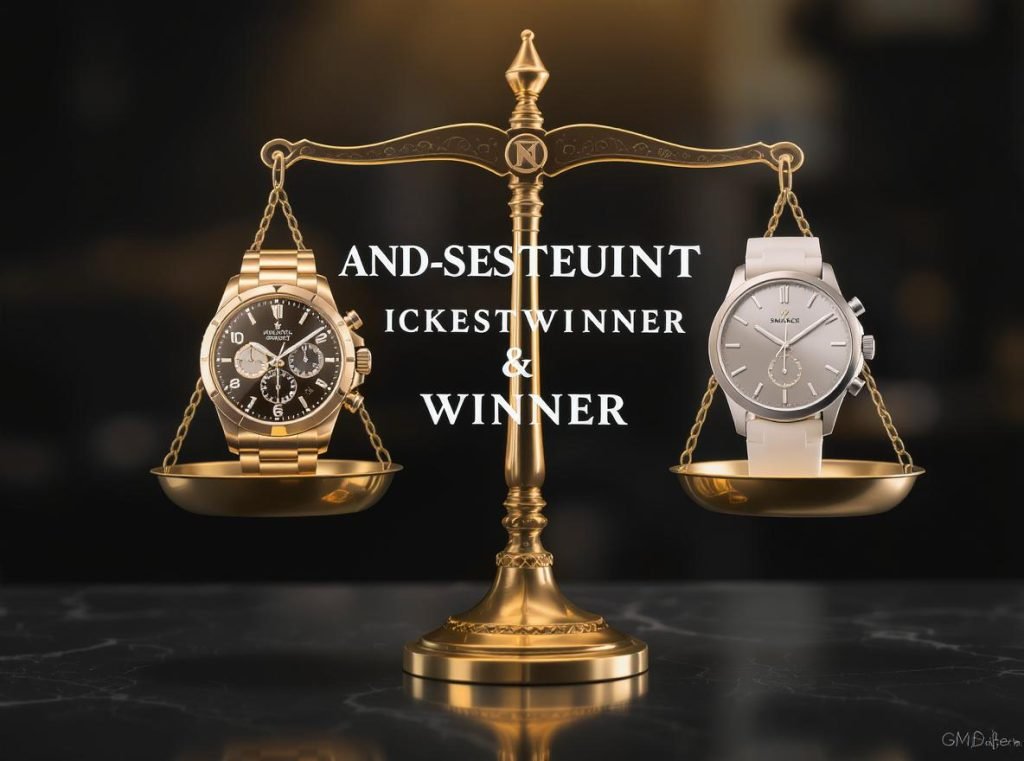
Choose Traditional Luxury Watches When:
- Investment appreciation represents a primary purchase motivation
- Time horizon extends 5+ years for optimal return potential
- Appreciation for mechanical craftsmanship and heritage appeals personally
- Budget accommodates established brands ($5,000+ entry point)
- Portfolio diversification with tangible assets provides strategic value
Choose Smartwatches When:
- Advanced functionality and connectivity features drive purchase decisions
- Technology depreciation acceptance aligns with normal device upgrade patterns
- Health monitoring and fitness tracking provide significant personal value
- Budget constraints favor lower initial investment requirements
- Regular device updates match personal technology preferences
Strategic Investment Framework:
Traditional luxury watches from established brands offer genuine investment potential supported by historical performance data, market stability, and strengthening demand trends. Smartwatches, including potentially competitive options like Osmarto products, serve important functional roles but require purchase decisions based on utility value rather than financial returns.
Optimal Dual Strategy:
For investors seeking both investment potential and modern functionality, the recommended approach involves carefully selected traditional luxury watches for wealth preservation purposes while utilizing smartwatches for daily technological convenience—recognizing each category serves distinctly different roles in personal utility and financial strategy implementation.
Final Investment Guidance:
The fundamental difference lies in purchasing a timeless mechanical instrument with decades of appreciation potential versus acquiring sophisticated technology that will inevitably be superseded by continued innovation. Both have legitimate roles, but only traditional luxury watches consistently build wealth over time.
Summary
Traditional luxury watches significantly outperform smartwatches as investment assets, delivering proven 9% annual returns with established brands achieving 20% appreciation rates. Smartwatches depreciate 40-98% within 2-3 years due to technological obsolescence, making them suitable for utility rather than investment purposes. Conservative investors should prioritize mechanical timepieces from heritage brands, while technology enthusiasts can enjoy smartwatch functionality without expecting financial returns.
Ready to explore premium smartwatch wholesale opportunities that complement traditional luxury watch markets? Contact Osmarto today to discover how our manufacturing expertise and competitive pricing help wholesale partners succeed in both technology and traditional timepiece segments.